Mastering Linear Equations in One Variable: The Ultimate Guide for Beginners
Learn linear equations in one variable with easy explanations, solved examples, real-life applications, and step-by-step solutions for beginners.
Read More → ATP Education

The definition of a limit is a numerical value that a function approaches as the input gets closer and closer to some value. The limit of the functions is represented in a general expression to evaluate its numerical result.
Contents:
limit,numerical,value,closer,definition,that,function,approaches,input,gets
In mathematics, the limit is a value that a function (or sequence) "approaches" as the input (or index) "approaches" some value. Limits are important in calculus and analysis in general.
Most of the limits that occur in practice have already been calculated and can be looked up in mathematical tables. In this blog post, we will go over the definition of a limit, the types of limits, how to calculate limits, and finally some examples of calculating limits.
The definition of a limit is a numerical value that a function approaches as the input gets closer and closer to some value. The limit of the functions is represented in a general expression to evaluate its numerical result. The general expression is:
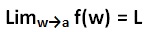
There are three types of limits:
Let us discuss the types of limits in calculus briefly.
A one-sided limit is defined as the maximum value that a function can reach when the input is close to but not exactly at that point.
For example, if you have a function that takes an input and returns an output, then its one-sided limit would be infinity (i.e., it can never reach this maximum value).
A two-sided limit is defined as the minimum and maximum values that a function can reach when the input is close to but not exactly at that point.
For example, if you have a function that takes an input and returns an output, then its two-sided limit would be -1 (i.e., it could theoretically reach this minimum or maximum value). Similarly, if you have a function that takes a float input and returns a floating output, then its two-sided limit would be 0 (i.e., it could theoretically reach this minimum or maximum value).
An infinite limit is simply defined as any number beyond which there's no known way to calculate the corresponding limit using standard methods like algebraic manipulation or the Sandwich Theorem.
For example, consider pi – 3 degrees Celsius: there's no known finite amount above which pi will increase by 3 degrees Celsius; instead, it continues on forever towards infinity. So technically speaking, pi has an infinite limit (although we don't know what it actually equals!).
To calculate a limit, you can use different methods depending on the type of limit you're dealing with. For one-sided limits, you can use substitution or factoring; for two-sided limits, you can use algebraic manipulation or graphing;
and for infinite Limits, you can use L’hopital’s rule.A L’hopital’s rule is a technique for calculating the numerical values of the indeterminate functions by taking the differential of the numerator and denominator and applying the value of the limit.
If the function again formsan indeterminate form, you have to take the second derivative of the function, and so on.
Let us take a few examples of limit calculus solved with the help of the laws of limit calculus.
Example 1:
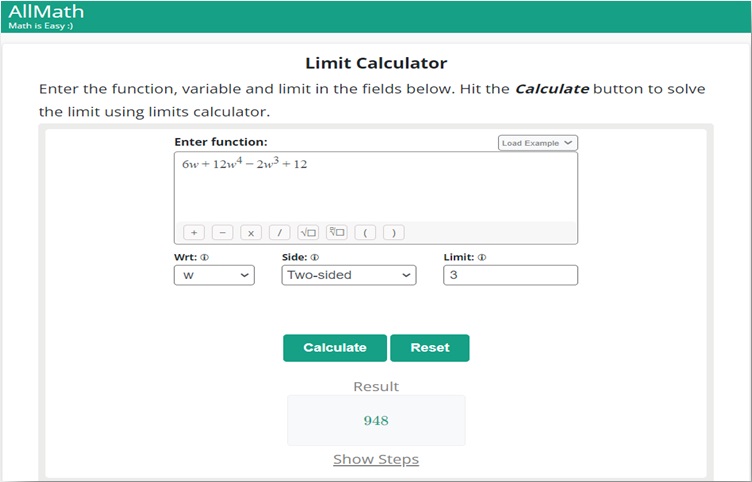
Evaluate the limit of the given function if the particular point “w” approaches 3.
f(w) = 6w + 12w4 – 2w3 + 12
Solution
Step 1:First of all, apply the notation of limit calculus to the given function along with the value of the specific point.
Limw→af(w) = Limw→3[6w + 12w4 – 2w3 + 12]
Step 2:Now use the sum and difference laws of limit calculus to apply the notation of limit with each term of the function separately and take out the constant coefficients.
Limw→3[6w + 12w4 – 2w3 + 12] = Limw→3[6w] + Limw→3[12w4] – Limw→3[2w3] + Limw→3[12]
Limw→3[6w + 12w4 – 2w3 + 12] = 6Limw→3[w] + 12Limw→3[w4] – 2Limw→3[w3] + Limw→3[12]
Step 3:Now put the value of the particular point in the place of the independent variable of the above expression.
Limw→3[6w + 12w4 – 2w3 + 12] = 6[3] + 12[34] – 2[33] +[12]
= 6[3] + 12[3 x 3 x 3 x 3] – 2[3 x 3 x 3] +[12]
= 6[3] + 12[81] – 2[27] +[12]
= 18 + 972 – 54 +12
= 990 – 54 +12
= 936 +12
= 948
A limit calculator with steps can be used to evaluate the limits to ease up the lengthy and time consuming calculations
Example 2:
Calculate the limit of the given function if the particular point “w” approaches 2.
h(t) = (2t3 – 2t2 – 8) / (t2 – 22)
Solution
Step 1:First of all, apply the notation of limit calculus to the given function along with the value of the specific point.
Limt→ah(t) = Limt→2[(2t3 – 2t2 – 8) / (t2 – 22)]
Step 2:Now use the sum and difference laws of limit calculus to apply the notation of limit with each term of the function separately and take out the constant coefficients.
Limt→2[(2t3 – 2t2 – 8) / (t2 – 22)] = (Limt→2[2t3] – Limt→2[2t2]– Limt→2[8]) / (Limt→2[t2] – Limt→2[22])
Limt→2[(2t3 – 2t2 – 8) / (t2 – 22)] = (2Limt→2[t3] – 2Limt→2[t2]– Limt→2[8]) / (Limt→2[t2] – Limt→2[22])
Step 3:Now put the value of the particular point in the place of the independent variable of the above expression.
Limt→2[(2t3 – 2t2 – 8) / (t2 – 22)] = (2[23] – 2[22]–[8]) / ([22] –[22])
Limt→2[(2t3 – 2t2 – 8) / (t2 – 22)] = (2[8] – 2[4]–[8]) / ([4] –[4])
Limt→2[(2t3 – 2t2 – 8) / (t2 – 22)] = (16 – 8–8) / (4 –4)
Limt→2[(2t3 – 2t2 – 8) / (t2 – 22)] = 0/0
Step 4:Now use L’hopital’s rule of limit calculus as the given function makes an indeterminate form.
Limt→2[(2t3 – 2t2 – 8) / (t2 – 22)] = Limt→2[d/dt (2t3 – 2t2 – 8) / d/dt (t2 – 22)]
Limt→2[(2t3 – 2t2 – 8) / (t2 – 22)] = Limt→2[(6t2 – 4t– 0) / (2t – 0)]
Limt→2[(2t3 – 2t2 – 8) / (t2 – 22)] = Limt→2[(6t2 – 4t) / (2t)]
Step 5: Now again put the value of the particular point in the place of the independent variable of the above expression.
Limt→2[(2t3 – 2t2 – 8) / (t2 – 22)] = (Limt→2[6t2] – Limt→2[4t]) / (Limt→2[2t])
Limt→2[(2t3 – 2t2 – 8) / (t2 – 22)] = (6(2)2 – 4(2)) / (2(2))
Limt→2[(2t3 – 2t2 – 8) / (t2 – 22)] = (6(4) – 4(2)) / (2(2))
Limt→2[(2t3 – 2t2 – 8) / (t2 – 22)] = (24 – 8) / (4)
Limt→2[(2t3 – 2t2 – 8) / (t2 – 22)] = (16) / (4) = 4
Example 3:
Find the limit of the given function if the particular point “w” approaches 1.
f(u) = 2u2 / 3u * 12u3 / 2u
Solution
Step 1:First of all, take the given function p(r) and apply the limit notation to it.
Limu→af(u) = Limu→1[2u2 / 3u * 12u3 / 2u]
Step 2:Now apply the limit notation to each function separately with the help of product and quotient laws of limit calculus.
Limu→1[2u2 / 3u * 12u3 / 2u] = Limu→1[2u2] / Limu→1[3u] * Limu→1[12u3] / Limu→1[2u]
Limu→1[2u2 / 3u * 12u3 / 2u] = 2Limu→1[u2] / 3Limu→1[u] * 12Limu→1[u3] / 2Limu→1[u]
Step 3:Now substitute r = 1 to the above expression.
Limu→1[2u2 / 3u * 12u3 / 2u] = 2[12] / 3[1] * 12[13] / 2[1]
= 2[1] / 3[1] * 12[1] / 2[1]
= 2 / 3 * 12 / 2
= 0.67 * 12 / 2
= 8 / 2
= 4
Now you can get all the basics of limits in calculus from this post. We have discussed all the basics of limits such as their definition, types, and calculation along with examples. Once you go through this post, you are able to solve any problem of limit.

Learn linear equations in one variable with easy explanations, solved examples, real-life applications, and step-by-step solutions for beginners.
Read More →
Learn Degree of Comparison in English Grammar in easy Hindi. Understand Positive, Comparative and Superlative degrees with rules, examples, exercises, tricks and real-life usage.
Read More →
Get the latest Class 9 NCERT Solutions based on the new syllabus and updated books including Ganit Manjari, Exploration, Kaveri, and Ganga. Find chapter-wise solutions, question answers, MCQs, extra questions, summaries, and easy explanations for Maths, Science, English, and Hindi in one place.
Read More →
भारत के सर्वोच्च न्यायालय की संरचना, शक्तियाँ, अधिकार क्षेत्र, न्यायाधीशों की नियुक्ति, न्यायिक समीक्षा, PIL और महत्वपूर्ण निर्णयों की विस्तृत जानकारी। UPSC एवं अन्य प्रतियोगी परीक्षाओं के लिए सम्पूर्ण नोट्स।
Read More →
भारतीय संविधान में अब तक हुए 105 संशोधनों का वर्षवार विस्तृत विवरण जानें। किस सरकार में कौन-सा संशोधन हुआ, प्रमुख प्रावधान, महत्वपूर्ण अनुच्छेद और परीक्षा हेतु मुख्य बिंदु एक ही स्थान पर पढ़ें।
Read More →
In the world of school education, NCERT books play a very important role for students studying in CBSE and many other state boards. These textbooks are designed by experts and contain concept-based learning that helps students build a strong academic foundation.
Read More →