Confused between CBSE and Common Core standards? Compare structure, subjects, assessments & teaching philosophy in this detailed 2026 guide.
Contents:
CBSE vs Common Core, CBSE vs American curriculum, Common Core standards explained, CBSE curriculum for NRI students, Indian curriculum vs US curriculum
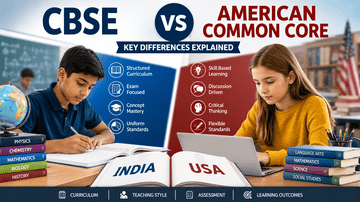
CBSE vs American Common Core: Key Differences Explained
Parents moving between India and the United States often face the same question: how does the Central Board of Secondary Education (CBSE) compare to the Common Core State Standards used across most American schools? While both systems aim to build strong academic foundations, they differ sharply in structure, teaching philosophy, assessment style, and even the age at which students specialize in subjects. This guide breaks down those differences in detail so parents, educators, and students can make informed decisions.
What is CBSE?
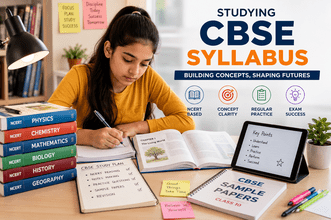
CBSE is a national-level education board in India that governs curriculum, textbooks, and examinations for thousands of affiliated schools across the country and in several other nations. It is best known for its structured, textbook-driven approach, with the National Council of Educational Research and Training (NCERT) supplying most of the standard learning material. CBSE follows a fairly uniform syllabus nationwide, meaning a Class 8 student in Delhi and a Class 8 student in Chennai are typically studying the same chapters in the same order.
What is Common Core?
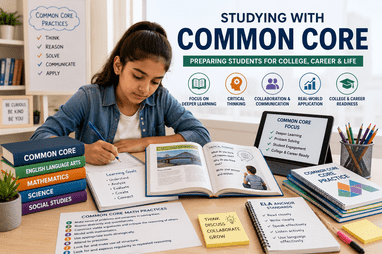
Common Core is not a national curriculum in the way CBSE is. It is a set of academic standards in mathematics and English language arts that outline what students should know at the end of each grade level. Individual states voluntarily adopted these standards starting around 2010, and each state, district, or even individual school retains freedom to choose its own textbooks, teaching methods, and pacing, as long as students eventually meet the specified benchmarks. Some states have since modified or renamed their standards, so the exact implementation varies from one place to another.
Key Structural Differences
1. Centralization vs. Flexibility
CBSE operates on a centralized model. The board prescribes textbooks, sets exam patterns, and releases a fixed academic calendar that schools are expected to follow closely. Common Core, in contrast, only defines learning outcomes. Two schools in neighboring towns in the same state could use completely different textbooks and teaching approaches while both meeting Common Core benchmarks.
2. Subject Scope
CBSE mandates a wide subject spread through Class 10, including science, social studies, mathematics, and languages, with limited choice until students reach Class 11. Common Core, being limited to math and English language arts, does not govern science, history, or other subjects at all. Those are typically guided by separate state or district frameworks, such as the Next Generation Science Standards in some states.
3. Assessment Style
CBSE assessments rely heavily on board examinations, particularly the Class 10 and Class 12 board exams, which carry significant weight for college admissions and are largely written-response and long-form in nature. Common Core schools generally use a mix of classroom assessments, standardized state tests, and continuous evaluation throughout the year, with far less emphasis placed on a single high-stakes exam.
4. Teaching Philosophy
CBSE has traditionally leaned toward structured, textbook-based learning with an emphasis on memorization and accuracy, though recent reforms under the National Education Policy have pushed toward more conceptual and skill-based teaching. Common Core was specifically designed around conceptual understanding and applied reasoning, particularly in mathematics, encouraging students to explain their reasoning process rather than just arrive at a correct answer.
5. Grade-Level Transitions
CBSE students choose a stream (Science, Commerce, or Humanities) starting in Class 11, which significantly narrows their subject list. American students under Common Core generally continue a broader, less specialized course load through high school graduation, with subject choice driven more by elective credits than by a fixed stream system.
Which System Prepares Students Better?
Neither system is objectively superior; they are built for different goals. CBSE's structured approach tends to produce students with strong foundational knowledge and exam discipline, which can be an advantage in competitive entrance tests common in India. Common Core's flexible, concept-first approach tends to build stronger problem-solving and communication skills, which aligns well with how American colleges evaluate applicants through a more holistic process involving essays, extracurriculars, and letters of recommendation alongside grades.
What This Means for NRI and Relocating Families
Families moving from India to the US, or vice versa, should expect an adjustment period. A CBSE student entering a Common Core school may find the pace of a single subject slower but the expectation for independent reasoning and class participation much higher. Conversely, a student moving from a Common Core school into a CBSE-affiliated school abroad may need to catch up on the sheer volume of syllabus content and adjust to a heavier emphasis on scoring well in board-style examinations.
It also helps to know that CBSE is recognized in many countries with a significant Indian diaspora, and several schools abroad, particularly in the Gulf countries, offer a CBSE-affiliated track specifically for expatriate families. However, in the US, CBSE recognition is handled on a case-by-case basis by individual school districts and colleges, so families are generally advised to keep transcripts, syllabus documents, and grading scales well organized when transferring.
Quick Comparison Summary
| Aspect | CBSE | Common Core |
| Governing Body | Single national board | State-adopted standards, no single board |
| Subjects Covered | All core subjects | Only math and English language arts |
| Textbooks | Largely standardized (NCERT) | Chosen by state, district, or school |
| Assessment | Heavy emphasis on board exams | Continuous assessment plus state testing |
| Specialization | Begins in Class 11 (stream choice) | Minimal, choice-based electives throughout |
| Teaching Style | Traditionally structured, increasingly skill-based | Concept and reasoning driven |
Final Thoughts
Choosing between CBSE and a Common Core-aligned school ultimately depends on a family's long-term plans, whether the student intends to pursue higher education in India, the US, or elsewhere, and how much value is placed on structured, exam-focused learning versus flexible, concept-driven instruction. Both systems can prepare a student well when supported by consistent study habits and parental involvement, and understanding these structural differences early can make transitions between the two much smoother.
 ATP Education