 Welcome to ATP Education
 ATP Education
Clauses - Clause Definition And Types Of Clause - English Grammar
Clauses - Clause Definition And Types Of Clause - Explore complete English Grammar concepts Correction with clear rules, examples and exam-oriented practice exercises.
Topics Covered In This Article
English Grammar Notes, Tenses Rules and Examples, Parts of Speech Notes, Active and Passive Voice, Direct and Indirect Speech, Modals and Auxiliaries, Articles and Prepositions, Sentence Correction Practice, English Grammar for Exams, Board Exam Grammar Preparation, Grammar Rules with Examples, English Grammar Study Material
Clauses - Clause Definition And Types Of Clause - English Grammar
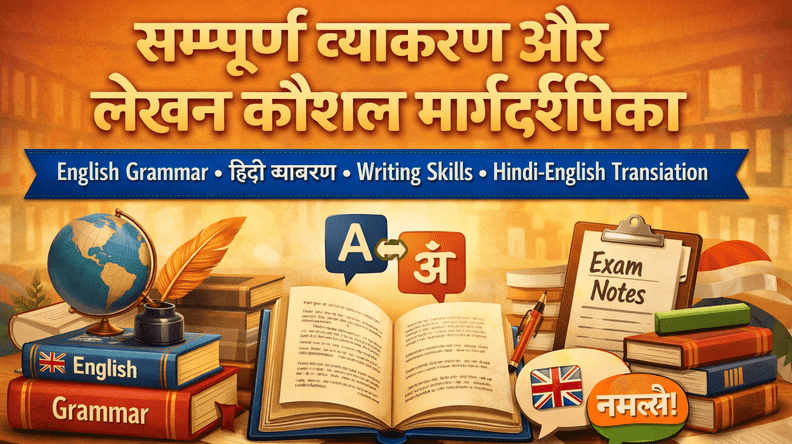
Explore comprehensive English Grammar, Hindi Vyakaran, Writing Skills, and Hindi–English Translation notes designed for clear concept building and exam preparation. This section covers essential grammar rules with examples, parts of speech, tenses, voice and narration, along with structured formats for letter writing and essay writing. Whether you are preparing for school exams or competitive tests, these well-organized and easy-to-understand notes will help you strengthen your language skills and improve accuracy in both Hindi and English.
Clauses - Clause Definition And Types Of Clause - English Grammar
Clauses
Clause Definition And Types Of Clause
Clause in English Grammar – Detailed Notes
Definition: A clause is a group of words that contains a subject and a verb. A clause may form part of a sentence or may itself be a complete sentence. Understanding clauses is essential for mastering sentence structure, complex sentences, and advanced grammar used in board and competitive examinations.
1. Types of Clauses
A. Independent Clause (Main Clause)
An independent clause expresses a complete thought and can stand alone as a sentence.
Example: She completed her work.
This clause has a subject (She) and a verb (completed) and gives a complete meaning.
B. Dependent Clause (Subordinate Clause)
A dependent clause cannot stand alone. It depends on the main clause to complete its meaning.
Example: because she was tired
This clause has a subject and verb but does not form a complete sentence.
2. Types of Subordinate Clauses
1. Noun Clause
A noun clause functions as a noun in a sentence. It can act as a subject, object, or complement.
Examples:
- I know that he is honest. (Object)
- What she said is true. (Subject)
- The fact is that she passed. (Complement)
Common words introducing noun clauses: that, what, whether, if, who, whoever, why, how.
2. Adjective Clause (Relative Clause)
An adjective clause modifies a noun or pronoun. It usually begins with relative pronouns like who, whom, whose, which, that.
Examples:
- The book that you gave me is interesting.
- The girl who won the prize is my sister.
Defining Clause: Essential information (no commas).
Non-Defining Clause: Extra information (uses commas).
3. Adverb Clause
An adverb clause modifies a verb, adjective, or another adverb. It tells us about time, reason, condition, contrast, place, purpose, or result.
Types of Adverb Clauses:
- Time: when, while, after, before
Example: I called you when I reached home. - Reason: because, since, as
Example: She stayed home because she was ill. - Condition: if, unless, provided that
Example: If you work hard, you will succeed. - Contrast: although, though, even though
Example: Although he was tired, he continued working. - Result: so…that
Example: He spoke so loudly that everyone heard him. - Purpose: so that, lest
Example: Study hard so that you may pass.
3. Clause vs Phrase
Clause: Has subject + verb.
Example: because she was ill
Phrase: Does not have subject + verb.
Example: because of illness
4. Important Grammar Rules (Exam Point of View)
- Do not use double conjunctions: ❌ I don’t know that why he left.
✔ I don’t know why he left. - Indirect questions use statement order:
✔ She asked where I was going. (Not: where was I going) - After “as if/as though” use subjunctive “were” for unreal comparison:
✔ She speaks as if she were the boss. - Inversion after negative adverbs:
✔ No sooner had he arrived than the meeting began.
5. Reduction of Clauses
Sometimes clauses can be reduced to phrases.
- Although he was tired → Being tired
- The boy who is playing → The boy playing
- Because he was ill → Being ill
6. Clause in Competitive Exams
Clauses are frequently tested in:
- Error Detection
- Sentence Improvement
- Fill in the Blanks
- Transformation of Sentences
- Para-jumbles
Conclusion
A strong understanding of clauses helps students construct complex and compound sentences accurately. Mastery of noun clauses, adjective clauses, and adverb clauses is essential for board exams as well as competitive exams like SSC, Banking, NDA, and CUET. Regular practice and error analysis are the keys to mastering clauses in English grammar.
English Grammar Chapters:
Comprehensive Hindi Vyakaran Study Material
In addition to English grammar, this guide provides detailed Hindi Vyakaran Notes covering essential grammar topics required in school and board examinations.
- संज्ञा और उसके भेद
- सर्वनाम
- विशेषण
- क्रिया और काल
- वचन और लिंग
- समास
- संधि
- अलंकार
- मुहावरे और लोकोक्तियाँ
Each topic is explained with examples and easy definitions to improve conceptual clarity.
Writing Skills for Academic Excellence
Strong Writing Skills are essential for scoring well in language papers. Structured writing demonstrates clarity of thought and proper grammar application.
Key Writing Formats Covered:
- Letter Writing Format (Formal & Informal)
- Essay Writing
- Paragraph Writing
- Notice Writing
- Application Writing
Students are guided with proper format, structure, tone, and model examples to ensure exam-ready preparation.