 Welcome to ATP Education
 ATP Education
Orienting Yourself: The Use of Coordinates Class 9 Mathematics Ganita Manjari Solutions English Medium-End-of-Chapter Exercises
Orienting Yourself: The Use of Coordinates Class 9 Mathematics Ganita Manjari Solutions English Medium-End-of-Chapter Exercises Get chapter-wise detailed explanations, step-by-step answers, important questions and exam-ready study material in Hindi and English medium.
Topics Covered In This Article
Orienting Yourself: The Use of Coordinates Class 9 Mathematics Ganita Manjari Solutions English Medium-End-of-Chapter Exercises, NCERT Solutions for CBSE Board Classes 6 to 12, ncert solutions for all classes, NCERT SOLUTIONS, online NCERT solutions, NCERT, ncert, ncert solutions, ncert solutions for board exams, ncert Maths solution, Mathematics, ncert science solutions, ncert English book solutions, ncert Hindi book solutions, ncert Social Science book solutions, ncert accounts book solutions, Computer Education, solved question answer for all exercise
Orienting Yourself: The Use of Coordinates Class 9 Mathematics Ganita Manjari Solutions English Medium-End-of-Chapter Exercises
NCERT Solutions for Class 9 are specially prepared according to the latest CBSE syllabus (2026-27) to help students understand every concept clearly. These solutions provide step-by-step explanations, accurate answers, and exam-oriented guidance for all chapters. Class 9 students can improve their problem-solving skills, strengthen conceptual understanding, and prepare confidently for school as well as board examinations. All questions are solved in a simple and easy-to-understand language for both Hindi and English medium learners.
Orienting Yourself: The Use of Coordinates Class 9 Mathematics Ganita Manjari Solutions English Medium-End-of-Chapter Exercises
NCERT Solutions Class 9 Mathematics Ganita Manjari English Medium
Orienting Yourself: The Use of Coordinates
Topic: End-of-Chapter Exercises
Q1. What are the x-coordinate and y-coordinate of the point of intersection of the two axes?
Solutions:
Q1. The point of intersection of x-axis and y-axis is the origin. So, coordinates = (0, 0).
Q2. Point W has x-coordinate equal to – 5. Can you predict the coordinates of point H which is on the line through W parallel to the y-axis? Which quadrants can H lie in?
Solutions:
Q2. Given W has x-coordinate = –5. Since H lies on a line parallel to y-axis, its x-coordinate will also be –5. So, H = (–5, y). Depending on y value, H can lie in Quadrant II (if y > 0) or Quadrant III (if y < 0).
Q3. Consider the points R (3, 0), A (0, – 2), M (– 5, – 2) and P (– 5, 2). If they are joined in the same order, predict:
(i) Two sides of RAMP that are perpendicular to each other.
(ii) One side of RAMP that is parallel to one of the axes.
(iii) Two points that are mirror images of each other in one axis. Which axis will this be?
Now plot the points and verify your predictions.
Solutions:
Q3. Given points: R(3, 0), A(0, –2), M(–5, –2), P(–5, 2)
(i) AM is horizontal (same y = –2) and MP is vertical (same x = –5). So, AM ⟂ MP.
(ii) AM is parallel to x-axis (y constant), and MP is parallel to y-axis (x constant). So, one such side is AM ∥ x-axis.
(iii) Points M(–5, –2) and P(–5, 2) are mirror images of each other across the x-axis.
Q4. Plot point Z (5, – 6) on the Cartesian plane. Construct a right-angled triangle IZN and find the lengths of the three sides.
(Comment: Answers may differ from person to person.)
Q5. What would a system of coordinates be like if we did not have negative numbers? Would this system allow us to locate all the points on a 2-D plane?
Q*6. Are the points M (– 3, – 4), A (0, 0) and G (6, 8) on the same straight line? Suggest a method to check this without plotting and joining the points.
Q*7. Use your method (from Problem 6) to check if the points
R (– 5, – 1), B (– 2, – 5) and C (4, – 12) are on the same straight line.
Now plot both sets of points and check your answers.
Q*8. Using the origin as one vertex, plot the vertices of:
(i) A right-angled isosceles triangle.
(ii) An isosceles triangle with one vertex in Quadrant III and the other in Quadrant IV.
Q*9. The following table shows the coordinates of points S, M and T. In each case, state whether M is the midpoint of segment ST. Justify your answer.
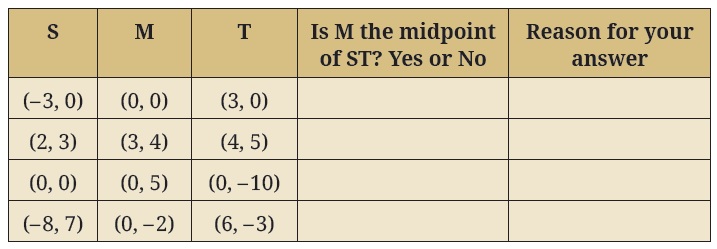
When M is the mid-point of ST, can you find any connection between the coordinates of M, S and T?
Q*10. Use the connection you found to find the coordinates of B given that M (–7, 1) is the midpoint of A (3, – 4) and B (x, y).
Q*11. Let P, Q be points of trisection of AB, with P closer to A, and Q closer to B. Using your knowledge of how to find the coordinates of the midpoint of a segment, how would you find the coordinates of P and Q? Do this for the case when the points are A (4, 7) and B (16, –2).
Q*12. (i) Given the points A (1, – 8), B (– 4, 7) and C (–7, – 4), show that they lie on a circle K whose center is the origin O (0, 0). What is the radius of circle K?
(ii) Given the points D (– 5, 6) and E (0, 9), check whether D and E lie within the circle, on the circle, or outside the circle K.
Q*13. The midpoints of the sides of triangle ABC are the points D, E, and F. Given that the coordinates of D, E, and F are (5, 1), (6, 5), and (0, 3), respectively, find the coordinates of A, B and C.
Q14. A city has two main roads which cross each other at the centre of the city. These two roads are along the North–South (N–S) direction and East–West (E–W) direction. All the other streets of the city run parallel to these roads and are 200 m apart. There are 10 streets in each direction.
(i) Using 1 cm = 200 m, draw a model of the city in your notebook. Represent the roads/streets by single lines.
(ii) There are street intersections in the model. Each street intersection is formed by two streets — one running in the N–S direction and another in the E–W direction. Each street intersection is referred to in the following manner: If the second street running in the N–S direction and 5th street in the E–W direction meet at some crossing, then we call this street intersection (2, 5). Using this convention, find:
(a) how many street intersections can be referred to as (4, 3).
(b) how many street intersections can be referred to as (3, 4).
Q15. A computer graphics program displays images on a rectangular screen whose coordinate system has the origin at the bottom-left corner. The screen is 800 pixels wide and 600 pixels high. A circular icon of radius 80 pixels is drawn with its centre at the point A (100, 150). Another circular icon of radius 100 pixels is drawn with its centre at the point B (250, 230). Determine:
(i) whether any part of either circle lies outside the screen.
(ii) whether the two circles intersect each other.
Q16. Plot the points A (2, 1), B (–1, 2), C (–2, –1), and D (1, –2) in the coordinate plane. Is ABCD a square? Can you explain why? What is the area of this square?
All Topics From Orienting Yourself: The Use of Coordinates
See other sub-topics of this chapter:
1. Exercise Set 1.1 2. Exercise Set 1.2 3. End-of-Chapter ExercisesNCERT Solutions Class 9 Hindi and English Medium – Complete Study Material
NCERT Solutions Class 9 students ke liye specially CBSE latest syllabus (2026-27) ke according prepare kiye gaye hain. Yeh solutions Hindi aur English medium dono ke liye available hain, jisse har student apni language preference ke hisaab se padh sakta hai. Har chapter ke sabhi prashnon ke step-by-step answers diye gaye hain jo concept clarity aur exam preparation me madad karte hain.
Chapter-Wise Detailed Explanations
Class 9 ke liye diye gaye Chapter Wise NCERT Solutions me har question ka detailed aur easy explanation diya gaya hai. Chahe aap CBSE Board Exam Preparation kar rahe ho ya school test ke liye revise kar rahe ho, yeh solutions aapko complete understanding denge. Har answer simple language me likha gaya hai jisse students concepts ko easily grasp kar saken.
Hindi and English Medium Support
Students Hindi aur English medium dono me NCERT Book Solutions Class 9 access kar sakte hain. Yeh dual language support un students ke liye helpful hai jo apni regional language me better samajhna chahte hain. Sabhi answers CBSE Latest Syllabus 2026-27 ke anusaar update kiye gaye hain.
Important Features of NCERT Solutions
- Class 9 NCERT Solutions PDF
- CBSE Class 9 Study Material
- NCERT Book Questions and Answers
- Exam Oriented Important Questions
- Step-by-Step Detailed Solutions
- Concept Clarity and Revision Notes
Why Students Should Use NCERT Solutions?
Aaj ke competitive environment me sirf textbook padhna kaafi nahi hota. NCERT Solutions for Class 9 students ko practice aur conceptual understanding dono provide karte hain. Yeh solutions unhe exam pattern samajhne, frequently asked questions practice karne aur high score achieve karne me madad karte hain. Regular practice se students apne weak topics ko improve kar sakte hain.
Best Resource for Exam Preparation
Agar aap Class 9 CBSE Preparation ke liye ek trusted aur reliable source dhundh rahe hain, to yeh NCERT Solutions perfect choice hain. Yeh study material school exams, unit tests, half-yearly aur annual exams ke liye equally useful hai. Har chapter ke answers accurate, verified aur student-friendly format me diye gaye hain.
Isliye agar aap NCERT Solutions Class 9 Hindi and English Medium search kar rahe hain, to yahan aapko complete chapter-wise solutions milenge jo aapki academic journey ko strong aur confident banayenge.