 Welcome to ATP Education
 ATP Education
Introduction to Linear Polynomials Mathematics Ganita Manjari class 9 in English Medium ncert book solutions Exercise Set 2.6
Introduction to Linear Polynomials Exercise Set 2.6 – Complete NCERT Book Solutions for Class 9 Mathematics Ganita Manjari (English Medium). Get all chapter explanations, extra questions, solved examples and additional practice questions for Introduction to Linear Polynomials Exercise Set 2.6 to help you master concepts and score higher.

Introduction to Linear Polynomials Mathematics Ganita Manjari class 9 in English Medium ncert book solutions Exercise Set 2.6
NCERT Solutions for Class 9 Mathematics Ganita Manjari play an important role in helping students understand the concepts of the chapter Introduction to Linear Polynomials clearly. This chapter includes the topic Exercise Set 2.6, which is essential from both academic and examination point of view. The solutions provided here are prepared strictly according to the latest NCERT syllabus and follow the guidelines of CBSE to ensure accuracy and relevance. Each question is explained in a simple and student-friendly manner so that learners can grasp the concepts without confusion. These NCERT Solutions are useful for regular study, homework help, and exam preparation. All textbook questions are solved step by step to improve problem-solving skills and conceptual clarity. Students of Class 9 studying Mathematics Ganita Manjari can use these solutions to revise important topics, understand difficult questions, and practise effectively before examinations. The chapter Introduction to Linear Polynomials is explained in a structured way, making it easier for students to connect the theory with the topic Exercise Set 2.6. By studying these updated NCERT Solutions for Class 9 Mathematics Ganita Manjari, students can build a strong foundation, boost their confidence, and score better marks in school and board exams.
Introduction to Linear Polynomials
Exercise Set 2.6
Exercise Set 2.6
Q1. Draw the graphs of the following sets of lines. In each case, reflect on the role of ‘a’ and ‘b’.
Solution:
The general form of a linear equation is:
y = ax + b
where,
a = slope of the line
b = y-intercept
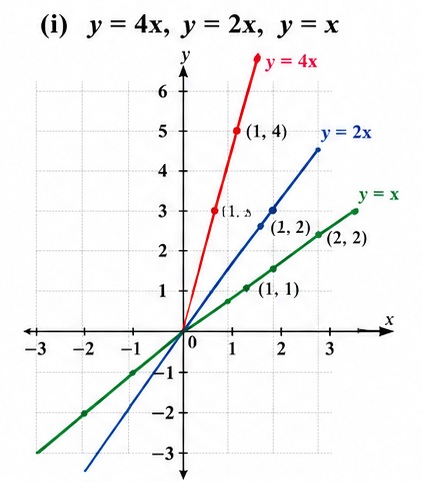
(i) y = 4x, y = 2x, y = x
Here,
a = 4, 2, 1
b = 0 in all cases
Observation:
As the value of a increases, the line becomes steeper.
Since b = 0, all lines pass through the origin (0, 0).
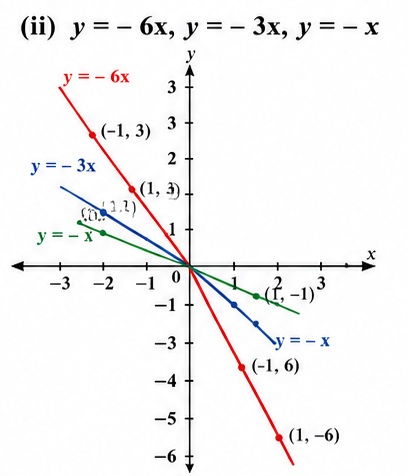
(ii) y = –6x, y = –3x, y = –x
Here,
a = –6, –3, –1
b = 0 in all cases
Observation:
Negative values of a give downward sloping lines.
Greater negative value means steeper downward slope.
Since b = 0, all lines pass through the origin.
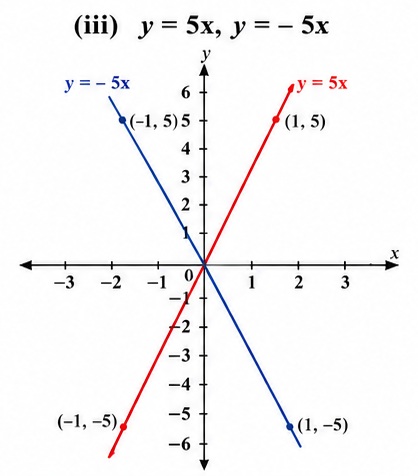
(iii) y = 5x, y = –5x
Here,
a = 5 and –5
b = 0
Observation:
Positive a gives an upward sloping line.
Negative a gives a downward sloping line.
Both lines pass through the origin because b = 0.
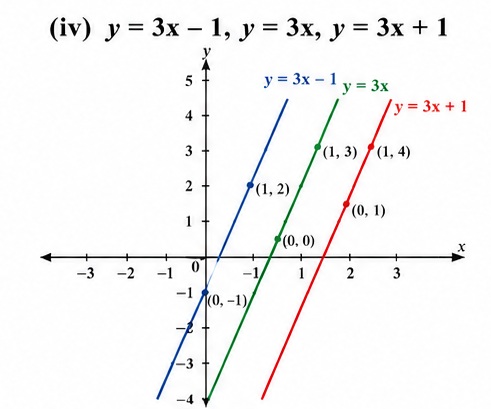
(iv) y = 3x – 1, y = 3x, y = 3x + 1
Here,
a = 3 in all cases
b = –1, 0, 1
Observation:
All lines have the same slope, so they are parallel.
Changing b shifts the line upward or downward.
b determines where the line cuts the y-axis.
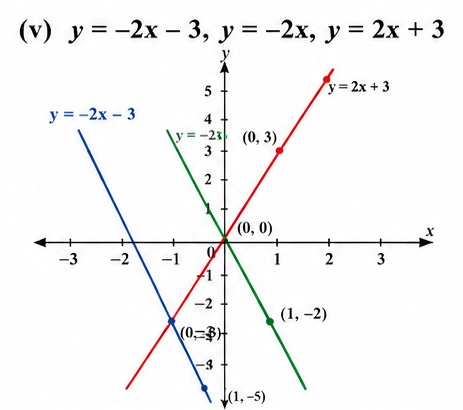
(v) y = –2x – 3, y = –2x, y = –2x + 3
Here,
a = –2 in all cases
b = –3, 0, 3
Observation:
All lines have the same negative slope, so they are parallel.
Changing b changes the y-intercept.
Negative b shifts the line downward and positive b shifts it upward.
See other sub-topics of this chapter:
1. Exercise Set 2.1 2. Exercise Set 2.2 3. Exercise Set 2.3 4. Exercise Set 2.4 5. Exercise Set 2.5 6. Exercise Set 2.6 7. End-of-Chapter Exercises