 Welcome to ATP Education
 ATP Education
Chapter 5. What Books And Burials Tell Us Class 6 History Solutions English Medium-NCERT Exercise
Chapter 5. What Books And Burials Tell Us Class 6 History Solutions English Medium-NCERT Exercise Get chapter-wise detailed explanations, step-by-step answers, important questions and exam-ready study material in Hindi and English medium.
Topics Covered In This Article
Chapter 5. What Books And Burials Tell Us Class 6 History Solutions English Medium-NCERT Exercise, NCERT Solutions for CBSE Board Classes 6 to 12, ncert solutions for all classes, NCERT SOLUTIONS, online NCERT solutions, NCERT, ncert, ncert solutions, ncert solutions for board exams, ncert Maths solution, Mathematics, ncert science solutions, ncert English book solutions, ncert Hindi book solutions, ncert Social Science book solutions, ncert accounts book solutions, Computer Education, solved question answer for all exercise
Chapter 5. What Books And Burials Tell Us Class 6 History Solutions English Medium-NCERT Exercise
NCERT Solutions for Class 6 are specially prepared according to the latest CBSE syllabus (2026-27) to help students understand every concept clearly. These solutions provide step-by-step explanations, accurate answers, and exam-oriented guidance for all chapters. Class 6 students can improve their problem-solving skills, strengthen conceptual understanding, and prepare confidently for school as well as board examinations. All questions are solved in a simple and easy-to-understand language for both Hindi and English medium learners.
Chapter 5. What Books And Burials Tell Us Class 6 History Solutions English Medium-NCERT Exercise
NCERT Solutions Class 6 History English Medium
Chapter 5. What Books And Burials Tell Us
Topic: NCERT Exercise
Exercise - Question:
Que: Match the columns
'Sukta' Stone boulder
Chariots Sacrifice
'Yajna' Well-said
'Dasa' Used in battles
Megalith Slave
Ans:
| Column | | Column || |
| Sukta | Well-said |
| Chariots | Used in battels |
| Yajna | Sacrifice |
| Dasa | Slave |
| Megalith | Stone boulder |
Que: Complete the sentences:
(a) Slaves were used for ————————
(b) Megaliths are found in ————————
(c) Stone circles or boulders on the surface were used to ————————
(d) Port-holes were used for ————————
(e) People at Inamgaon ate ————————
Ans:
(a) Various kind of work.
(b) Deccan in the north, east kashmir.
(c) Cover the burial places.
(d) Entering the burial places.
(e) Fruits, cereals and meat.
Que: In what ways are the books we read today different from the Rigveda?
Ans: The books we read today are printed on paper. The Rigveda used to be written on bitch bark.
Que: What kind of evidence from burials do archaeologists use to find out whether there were social differences amongst those who were buried?
Ans: Archealogists have found burial places which help them to reconstruct the past and tell about the socity. At Brahmagiri, the archaeologists have found one skeleton buried with 33 gold beads, 2 stone beads, 4 copper bangles and one conch shell. Other skeletons have only few pots. There burials suggest that there were some difference in status amongst the people who buried. Some were rich, other poor, some cheifs other followers.
Que: In what ways do you think that the life of a raja was different from that of a dasa or dasi?
Ans: The rajas did not have capitals, palaces or armis, not did they collect taxes. Generally the sons did not atumatically succeed fathers as rajas.
There were people who did not perfrom sacrifices and people spoke different languages. Later the team came to mean dasa or slave. Slave were men and women captured in the war. They were treated as the property of the owners, who could make them do any work them do any work they wanted.
Que: What kind of evidence from burials do archaeologists use to find out whether there were social differences amongst those who were buried?
Ans: Sometimes, archaeologists find a circle of stone boulders or a single large stone standing on the ground. These are the only indications that there are burials beneath.
All these burials have some common features. Generally, the dead were buried with distinctive pots, which are called Black and Red Ware. Also found are tools and weapons of iron and sometimes, skeleton of horses, horse equipment and ornaments of stone and gold.
Several kinds of evidences from burials do archaeologists use to find out that there were social differences amongst those who were buried underneath the megaliths. They think that objects found with a skeleton probably belonged to the dead person. Sometimes more objects were found in one grave than in another. For instance in Brahmagiri, one skeleton was buried with 33 gold beads, 2 stone beads, 4 copper bangles and one conch shell. Other skeletons had only a few pots. Perhaps there were differences in status amongst the people who were buried. Perhaps some were rich, others poor, some chiefs, others followers.
Que: In what ways do you think that the life of a ‘raja’ was different from that of a ‘dasa’ or ‘dasi’?
Ans: In the society, ‘raja’ was one of the highest civil positions. ‘Rajas’ were the kings of the community, whereas the ‘dasas’/’dasis’ were the lowest position in society. The ‘dasas’/’dasis’ were slaves who were used for work. They were treated as the property of their owners. They were captured in war.
Que: Find out whether your school library has a collection of books on religion, and list the names of five books from this collection.
Ans: Do yourself with the help of your subject-teacher and school librarian. A sample set of five such books:
- The Mahabharata
- The Ramayana
- The Bible
- The Bhagwad Gita
- The Quran
Que: Write down a short poem or song that you have memorised. Did you hear or read the poem or song? How did you learn it by heart?
Ans:
Que: In the Rigveda, people were described in terms of the work they did and the languages they spoke. In the table below, JiR in the names of six people you know, choosing three men and three women. For each of them, mention the work they do and the language they speak. Would you like to add anything else to the description?
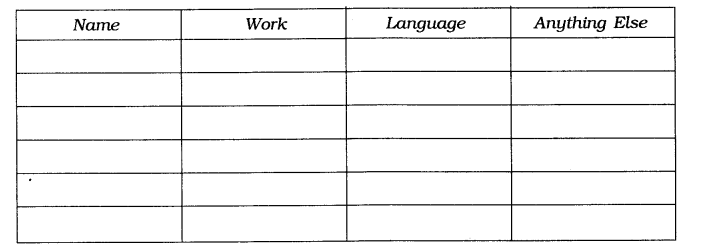 Ans: Do yourself.
All Topics From Chapter 5. What Books And Burials Tell Us
NCERT Solutions Class 6 Hindi and English Medium – Complete Study Material
NCERT Solutions Class 6 students ke liye specially CBSE latest syllabus (2026-27) ke according prepare kiye gaye hain. Yeh solutions Hindi aur English medium dono ke liye available hain, jisse har student apni language preference ke hisaab se padh sakta hai. Har chapter ke sabhi prashnon ke step-by-step answers diye gaye hain jo concept clarity aur exam preparation me madad karte hain.
Chapter-Wise Detailed Explanations
Class 6 ke liye diye gaye Chapter Wise NCERT Solutions me har question ka detailed aur easy explanation diya gaya hai. Chahe aap CBSE Board Exam Preparation kar rahe ho ya school test ke liye revise kar rahe ho, yeh solutions aapko complete understanding denge. Har answer simple language me likha gaya hai jisse students concepts ko easily grasp kar saken.
Hindi and English Medium Support
Students Hindi aur English medium dono me NCERT Book Solutions Class 6 access kar sakte hain. Yeh dual language support un students ke liye helpful hai jo apni regional language me better samajhna chahte hain. Sabhi answers CBSE Latest Syllabus 2026-27 ke anusaar update kiye gaye hain.
Important Features of NCERT Solutions
- Class 6 NCERT Solutions PDF
- CBSE Class 6 Study Material
- NCERT Book Questions and Answers
- Exam Oriented Important Questions
- Step-by-Step Detailed Solutions
- Concept Clarity and Revision Notes
Why Students Should Use NCERT Solutions?
Aaj ke competitive environment me sirf textbook padhna kaafi nahi hota. NCERT Solutions for Class 6 students ko practice aur conceptual understanding dono provide karte hain. Yeh solutions unhe exam pattern samajhne, frequently asked questions practice karne aur high score achieve karne me madad karte hain. Regular practice se students apne weak topics ko improve kar sakte hain.
Best Resource for Exam Preparation
Agar aap Class 6 CBSE Preparation ke liye ek trusted aur reliable source dhundh rahe hain, to yeh NCERT Solutions perfect choice hain. Yeh study material school exams, unit tests, half-yearly aur annual exams ke liye equally useful hai. Har chapter ke answers accurate, verified aur student-friendly format me diye gaye hain.
Isliye agar aap NCERT Solutions Class 6 Hindi and English Medium search kar rahe hain, to yahan aapko complete chapter-wise solutions milenge jo aapki academic journey ko strong aur confident banayenge.