 Welcome to ATP Education
 ATP Education
17. Stars And The Solar System Science class 8 in English Medium ncert book solutions Text Book Exercise
17. Stars And The Solar System Text Book Exercise – Complete NCERT Book Solutions for Class 8 Science (English Medium). Get all chapter explanations, extra questions, solved examples and additional practice questions for 17. Stars And The Solar System Text Book Exercise to help you master concepts and score higher.

17. Stars And The Solar System Science class 8 in English Medium ncert book solutions Text Book Exercise
NCERT Solutions for Class 8 Science play an important role in helping students understand the concepts of the chapter 17. Stars And The Solar System clearly. This chapter includes the topic Text Book Exercise , which is essential from both academic and examination point of view. The solutions provided here are prepared strictly according to the latest NCERT syllabus and follow the guidelines of CBSE to ensure accuracy and relevance. Each question is explained in a simple and student-friendly manner so that learners can grasp the concepts without confusion. These NCERT Solutions are useful for regular study, homework help, and exam preparation. All textbook questions are solved step by step to improve problem-solving skills and conceptual clarity. Students of Class 8 studying Science can use these solutions to revise important topics, understand difficult questions, and practise effectively before examinations. The chapter 17. Stars And The Solar System is explained in a structured way, making it easier for students to connect the theory with the topic Text Book Exercise . By studying these updated NCERT Solutions for Class 8 Science, students can build a strong foundation, boost their confidence, and score better marks in school and board exams.
17. Stars And The Solar System
Text Book Exercise
Exercise - Question:
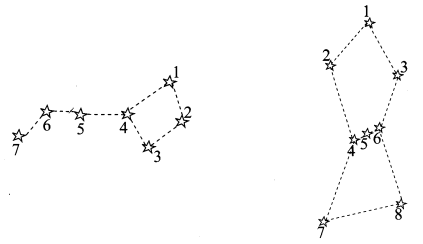
Que: Draw sketches to show the relative positions of prominent stars in
(a) Ursa Major and
(b) Orion
Ans:
(i) Ursa Major
(ii) Orion
Que: Name two objects other than planets which are members of the solar system.
Ans: Comets and asteroids.
Que: Explain how you can locate the Pole Star with the help of Ursa Major.
Ans: Pole star can be located with the help of two stars at the end of Ursa Major. Imagine a straight line passing through these stars. Extend the imaginary line in North direction. This line is about five times the distance between two stars. A star is seen in this direction which is called Pole star.
Que: Do all the stars in the sky move? Explain.
Ans: No, all the stars do not move in the sky. Due to the rotation of the Earth on its own axis stars seem to move in the sky.
Que: Why is the distance between stars expressed in light years? What do you understand by the statement that a star is eight light years away from the Earth?
Ans: The stars are very far away from the Earth and it is not convenient to express such distances in kilo¬metres. Thus, such large distances are expressed in unit known as light year.
If we say that a star is eight light years away from Earth, it means that the light from star will reach the Earth in eight years.
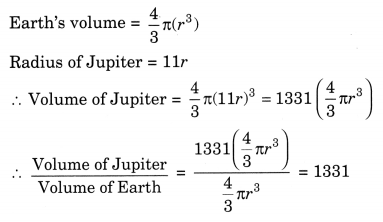
Que: The radius of Jupiter is 11 times the radius of the Earth. Calculate the ratio of the volumes of Jupiter and the Earth. How many Earths can Jupiter accomodate?
Ans: Let the radius of Earth be r units.
Que: Boojho made the following sketch (Fig. 17.6) of the solar system. Is the sketch correct or not, correct it.
Ans: No, the sketch made by Boojho is not correct. The correct sketch is given below:
See other sub-topics of this chapter:
1. Chapter Review 2. Text Book Exercise 3. Text Book Exercise 4. Additional Questions With Solutions 5. Additional Questions With Solutions