Welcome to ATP Education
 ATP Education
5. Data Handling Mathematics class 8 in English Medium ncert book solutions Exercise 5.2
5. Data Handling Exercise 5.2 – Complete NCERT Book Solutions for Class 8 Mathematics (English Medium). Get all chapter explanations, extra questions, solved examples and additional practice questions for 5. Data Handling Exercise 5.2 to help you master concepts and score higher.

5. Data Handling Mathematics class 8 in English Medium ncert book solutions Exercise 5.2
NCERT Solutions for Class 8 Mathematics play an important role in helping students understand the concepts of the chapter 5. Data Handling clearly. This chapter includes the topic Exercise 5.2, which is essential from both academic and examination point of view. The solutions provided here are prepared strictly according to the latest NCERT syllabus and follow the guidelines of CBSE to ensure accuracy and relevance. Each question is explained in a simple and student-friendly manner so that learners can grasp the concepts without confusion. These NCERT Solutions are useful for regular study, homework help, and exam preparation. All textbook questions are solved step by step to improve problem-solving skills and conceptual clarity. Students of Class 8 studying Mathematics can use these solutions to revise important topics, understand difficult questions, and practise effectively before examinations. The chapter 5. Data Handling is explained in a structured way, making it easier for students to connect the theory with the topic Exercise 5.2. By studying these updated NCERT Solutions for Class 8 Mathematics, students can build a strong foundation, boost their confidence, and score better marks in school and board exams.
5. Data Handling
Exercise 5.2
Exercise 5.2
- A survey was made to find the type of music that a certain group of young people liked in a city. Adjoining pie chart shows the finding of this survey.
- If 20 people liked classical music, how many young people were surveyed?
- Which type of music is liked by the maximum number of people?
- If a cassette company were to make 1000 CD’s, how many of each type would they make?
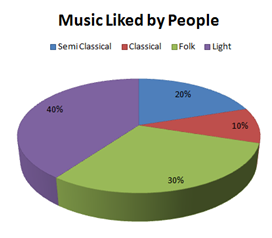
- Number of people who like classical music = 10 %
This 10% present 20 people.
So, 10% represent = = 200 people.
Therefore, 200 young people were surveyed.
- From the pie chart, it can be easily observed that the light music is represented by the maximum part of the pie chart 40%. Hence, most of the people like light music.
- Number of CD’s of classical music = 10% of 1000
= 100
So, the number of CD’s of semi classical music = 20% of 100
= = 200
So, the number of CD’s of folk music = 30%
= = 300
And the number of cassettes of light music = 40% of 1000
= = 400
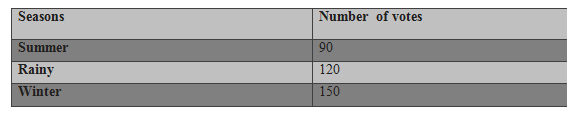
2. A group of 360 people were asked to vote for their favorite’s season from the three seasons rainy, winter and summer.
(i) Which season got the most votes?
(ii) Find the central angle of each sector.
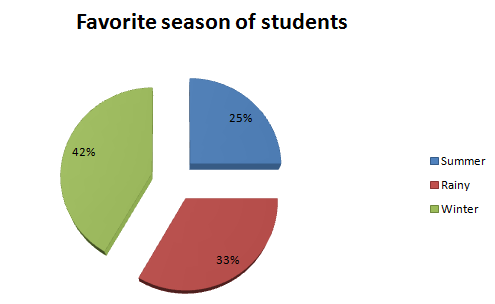
(iii) Draw a pie chart to show this information.
Answer:
- Winter.
- Total number of votes = 90 + 120+ 150 = 360
Question 3:
Draw a pie chart showing the following information.
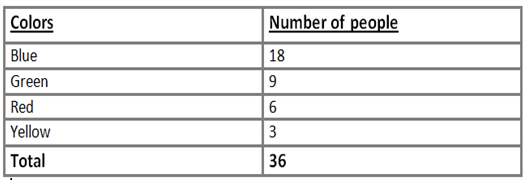
Ans:
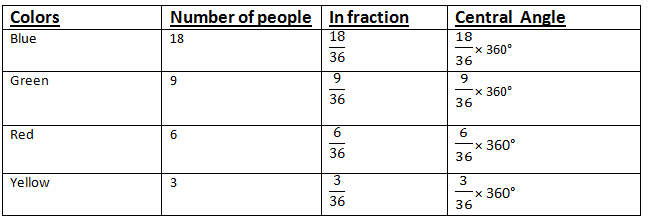
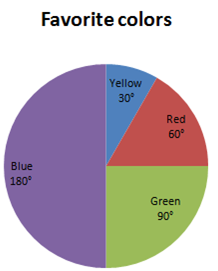
The central angle for each color can be calculated as follows.
Question:
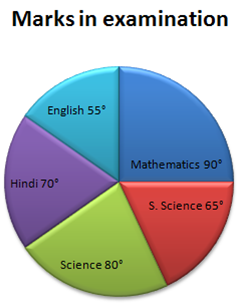
The adjoining pie chart gives the mark scored in a examination by a student in Hindi, English, Mathematics, Social science and science. If the total marks obtained by a student were 540, answer the following question.
In which subject did the students score 105 marks?
How many more marks were obtained by the students in mathematics than Hindi?
Examine whether the sum of the marks obtained in social science and mathematics is more than that in science and Hindi.
(HINT: Just study the angle.)
Answer:
The central angle of each subject can be calculated as follows
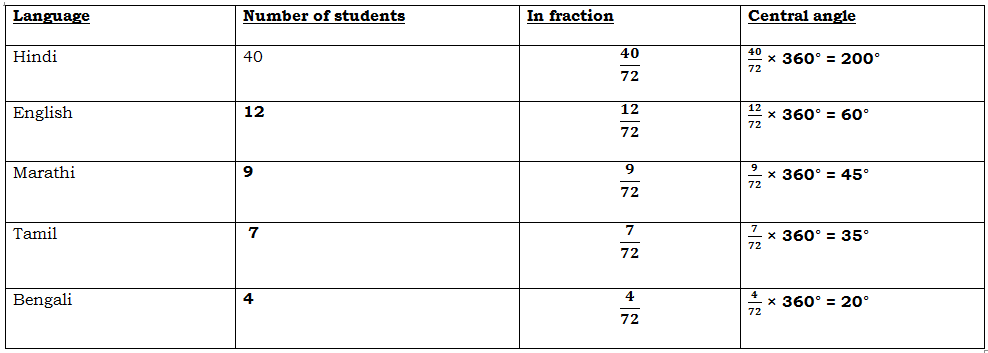
A pie chart of the above data is as follows.