 Welcome to ATP Education
 ATP Education
13. Direct and Inverse Proportions Mathematics class 8 in English Medium ncert book solutions Exercise 13.2
13. Direct and Inverse Proportions Exercise 13.2 – Complete NCERT Book Solutions for Class 8 Mathematics (English Medium). Get all chapter explanations, extra questions, solved examples and additional practice questions for 13. Direct and Inverse Proportions Exercise 13.2 to help you master concepts and score higher.

13. Direct and Inverse Proportions Mathematics class 8 in English Medium ncert book solutions Exercise 13.2
NCERT Solutions for Class 8 Mathematics play an important role in helping students understand the concepts of the chapter 13. Direct and Inverse Proportions clearly. This chapter includes the topic Exercise 13.2, which is essential from both academic and examination point of view. The solutions provided here are prepared strictly according to the latest NCERT syllabus and follow the guidelines of CBSE to ensure accuracy and relevance. Each question is explained in a simple and student-friendly manner so that learners can grasp the concepts without confusion. These NCERT Solutions are useful for regular study, homework help, and exam preparation. All textbook questions are solved step by step to improve problem-solving skills and conceptual clarity. Students of Class 8 studying Mathematics can use these solutions to revise important topics, understand difficult questions, and practise effectively before examinations. The chapter 13. Direct and Inverse Proportions is explained in a structured way, making it easier for students to connect the theory with the topic Exercise 13.2. By studying these updated NCERT Solutions for Class 8 Mathematics, students can build a strong foundation, boost their confidence, and score better marks in school and board exams.
13. Direct and Inverse Proportions
Exercise 13.2
Exercise 13.2
Q1. Which of the following are in inverse proportion?
(i) The number of workers on a job and the time to complete the job.
(ii) The time taken for a journey and the distance travelled in a uniform speed.
(iii) Area of cultivated land and the crop harvested.
(iv) The time taken for a fixed journey and the speed of the vehicle.
(v) The population of a country and the area of land per person.
Solution:
(i) Numbers of workers on a job and time always be in inverse proportion because when we increase in workers time reduces and when we reduce in workers time it take more time.
(ii) The time taken and distance are in direct proportion because if we increase in time it covers more distance. Hence both quantities increase together.
(iii) As area will be cultivated as more crops will be harvested. So these are direct proportion.
(iv) Time and speed always be in inverse proportion. As we increase the time we have to reduce the speed to cover a fixed distance. Similarly we see that if we increase the speed time reduces automatically.
(v) If population is increased area land will be short to live. Therefore these both quantity are in inverse proportion.
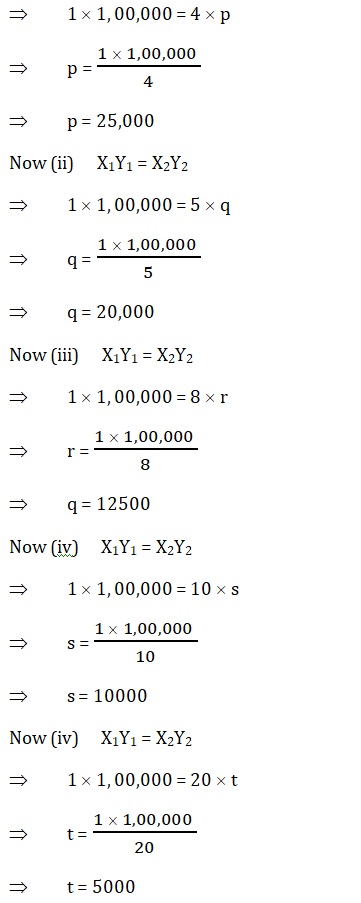
Q2. In a Television game show, the prize money of Rs 1,00,000 is to be divided equally amongst the winners. Complete the following table and find whether the prize money given to an individual winner is directly or inversely proportional to the number of winners?

Solution: Prize will be distributed to winner in inverse proportion.
As both quantities are in inverse proportion.
Suppose the table has …


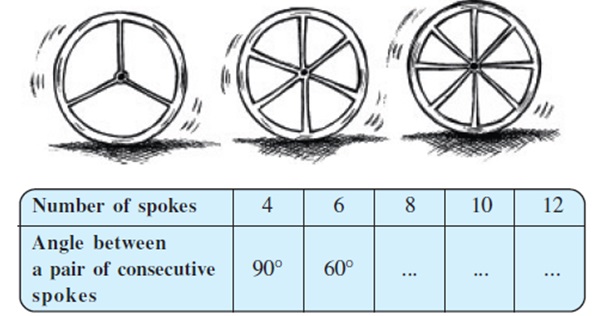
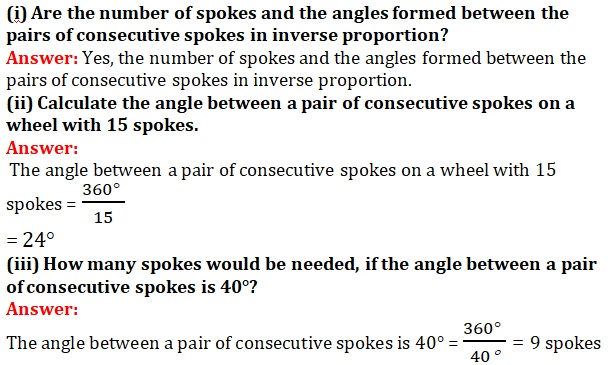
Q3. Rehman is making a wheel using spokes. He wants to fix equal spokes in such a way that the angles between any pair of consecutive spokes are equal. Help him by completing the following table.
Solution:
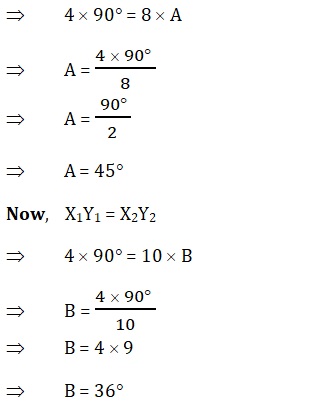
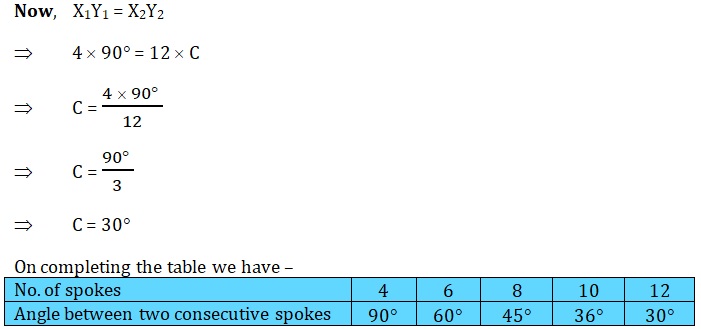
The relation between spokes and angle between consecutive spokes are in inverse proportion.
Therefore, X1Y1 = X2Y2
Q4. If a box of sweets is divided among 24 children, they will get 5 sweets each. How many would each get, if the number of the children is reduced by 4?
Solution:
According to question we have the table like this