 Welcome to ATP Education
 ATP Education
12. Areas Related to Circles Mathematics class 10 in English Medium ncert book solutions Exercise 12.1
12. Areas Related to Circles Exercise 12.1 – Complete NCERT Book Solutions for Class 10 Mathematics (English Medium). Get all chapter explanations, extra questions, solved examples and additional practice questions for 12. Areas Related to Circles Exercise 12.1 to help you master concepts and score higher.

12. Areas Related to Circles Mathematics class 10 in English Medium ncert book solutions Exercise 12.1
NCERT Solutions for Class 10 Mathematics play an important role in helping students understand the concepts of the chapter 12. Areas Related to Circles clearly. This chapter includes the topic Exercise 12.1, which is essential from both academic and examination point of view. The solutions provided here are prepared strictly according to the latest NCERT syllabus and follow the guidelines of CBSE to ensure accuracy and relevance. Each question is explained in a simple and student-friendly manner so that learners can grasp the concepts without confusion. These NCERT Solutions are useful for regular study, homework help, and exam preparation. All textbook questions are solved step by step to improve problem-solving skills and conceptual clarity. Students of Class 10 studying Mathematics can use these solutions to revise important topics, understand difficult questions, and practise effectively before examinations. The chapter 12. Areas Related to Circles is explained in a structured way, making it easier for students to connect the theory with the topic Exercise 12.1. By studying these updated NCERT Solutions for Class 10 Mathematics, students can build a strong foundation, boost their confidence, and score better marks in school and board exams.
12. Areas Related to Circles
Exercise 12.1
Exercise: 12.1
Q.1 The radii of two circles are 19 cm and 9 cm respectively. Find the radius of the circle which has circumference equal to the sum of the circumferences of the two circles.
Solution:
Let the radius of acquired circle = R
And radius of Large circle r1 = 19 cm
Radius of small circle r2 = 9 cm
Then,
2πR = 2πr1 + 2πr2
2πR = 2π (r1 + r2)
R = (r1 + r2)
= 19 + 9
= 28 cm
Q2. The radii of two circles are 8 cm and 6 cm respectively. Find the radius of the circle having area equal to the sum of the areas of the two circles.
Solution:
Let the radius of acquired circle = R
And radius of Large circle r1 = 8 cm
Radius of small circle r2 = 6 cm
Then,
πR2 = πr12 + πr22
πR2 = π (r12 + r22)
R2 = (r12 + r22)
= 82 + 62
= 64 + 36 cm
= 100 cm
R = √100 = 10 cm
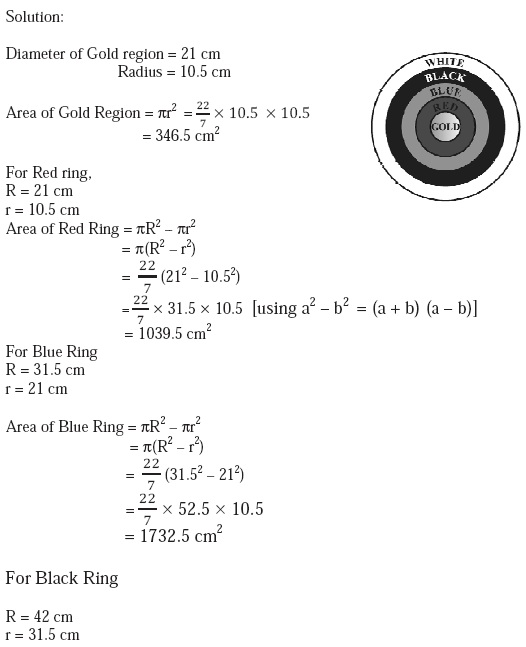
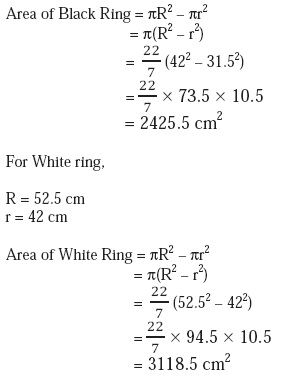
Q3. Depicts an archery target marked with its five scoring areas from the centre outwards as Gold, Red, Blue, Black and White. The diameter of the region representing Gold score is 21 cm and each of the other bands is 10.5 cm wide. Find the area of each of the five scoring regions.
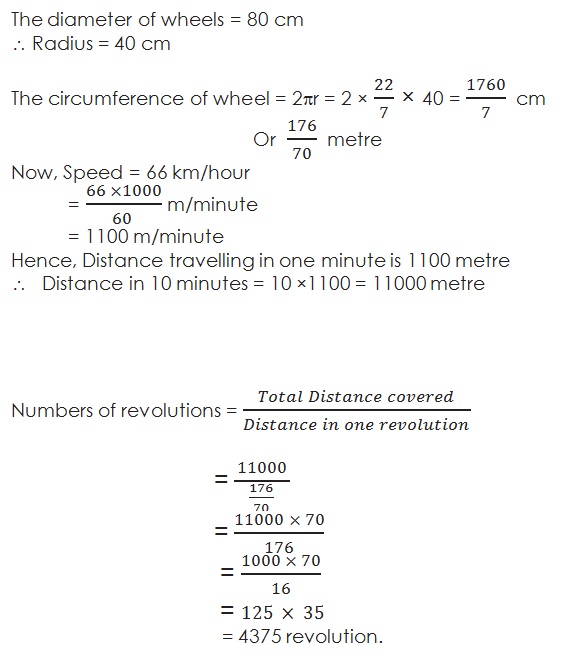
Q4. The wheels of a car are of diameter 80 cm each. How many complete revolutions does each wheel make in 10 minutes when the car is travelling at a speed of 66 km per hour?
Solution:
Q5. If the perimeter and the area of a circle are numerically equal, then find the radius of the circle.
Solution:
2πr = πr2
2r = r2
2r = r × r
r = 2 unit
See other sub-topics of this chapter:
1. Exercise 12.1 2. Exercise 12.2 3. Exercise 12.3 4. Exercise 12.4