 Welcome to ATP Education
 ATP Education
Chapter-2. The Invisible Living 2 World: Beyond Our Naked Eye Science Curiosity class 8 in english Medium CBSE Notes
CBSE Class 8 Science Curiosity Notes in English Medium based on latest NCERT syllabus, covering definitions, diagrams, formulas, and exam-oriented explanations.

2. The Invisible Living 2 World: Beyond Our Naked Eye
Important Notes
Chapter 2: The Invisible Living World
Introduction
The world around us contains many tiny living organisms that cannot be seen with the naked eye. These organisms can be observed using microscopes. The discovery of this invisible world has helped scientists understand life in a better way.
- The invention of the microscope opened to see and understand a fascinating hidden world filled with tiny living creatures.
- All plants and animals around us are of differents sizes, shapes and colours are also differ in many other features.
- All living beings, whether plants or animals, are called organisms.
1. Microorganisms
Microorganisms are tiny living organisms that cannot be seen with the naked eye.
Example: Bacteria, Ameoba, Yeast etc.
Types of Microorganisms:
1. Bacteria
2. Fungi
3. Protozoa
4. Algae
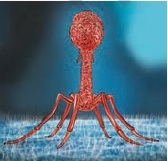
5. Virus (special case) : Virus is non-living organism outside of a body, but living organism inside a living body, it uses the all mechanisms of living body.
They may infect plants, animals, or bacterial cells and may cause a disease.
Some microorganisms are helpful for us:
- Some help in food making, like curd,
- Some help in decomposition
And some are foes for us which cause many diseases.
2. Discovery of Microorganisms And Cells
Discovery of living microorganisms first time in 1660s by Antonie van Leeuwenhoek was a scientist from the Netherlands who improved the design of lenses and microscopes. With these improved tools, he was able to observe very tiny living organisms that were invisible to the naked eye.
Use of microscope:
He was the first to study and describe microorganisms like bacteria and blood cells. Because of his important discoveries, he is known as the “Father of Microbiology.”
Learning Point: Leeuwenhoek is known as Father of Microbiology.
Discovery of cell: Cell is discovered by Robert Hooke in 1665. He looked at a thin slice of cork by using a newly powerful tool called microscope. This was the first time the word cell was used in science to describe the basic unit of life.
Cell Introduction:
All living beings are made up of cells. A cell is the basic structural and functional unit of life. Many cells come together to form tissues and build the body of an organism. Just like a house is constructed using bricks as its basic units, the body of living beings is formed by cells.
We can see any cell with help of microscope.
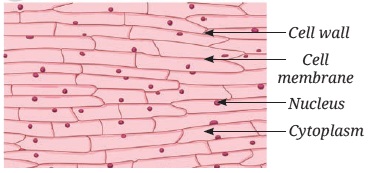
Cells of onion peels

Bricks in wall
Definition of Cell:
A cell is the smallest unit of life that can perform all basic life functions.
Examples:
- Onion peel cells
- Human cheek cells
Functions of Cell
- Controls life processes
- Helps in growth and reproduction
- Performs metabolic activities
- Stores essential nutrition and energy.
- It gives shape to all living beings.
- It performs all basic functions.
Types of cell:
1. Plant Cell – Plant cell has cell wall and chloroplast.
2. Animal Cell – Animal cell does not have cell wall.
3. Structure of Cell
Definition:
The structure of a cell refers to its different parts and their organization.
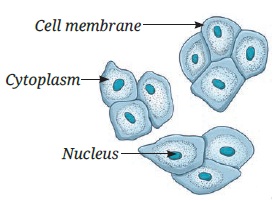
Common Parts of Cells: cell membrane, cytoplasm, and nucleus — are the basic parts of a cell.
- Cell membrane: The outer layer is called the cell membrane.
Functions of Cell membrane:
1. The cell membrane separates one cell from another.
2. It is porous and allows the entry of materials essential for life processes.
3. It also allow to exit of waste material.
- Cytoplasm: Cytoplasm is a jelly-like (semi-liquid) substance present inside the cell. It covers the major part of cell. It containts many cell elements which are called cell organells.
Functions of Cytoplasm:
1. Cytoplasm contains other components of the cell and compounds, such as carbohydrates, proteins, fats, and mineral salts.
2. Most of the life processes take place within the cytoplasm.
- Nucleus: The round structure in the middle of cell is called the nucleus, which is also covered by a thin membrane. This thin membrane, which covers the nucleus is called nucleus membrane.
Functions of Nucleus:
1. The nucleus regulates all activities that occur within the cell.
2. It also regulates growth.
3. Plant Cell:
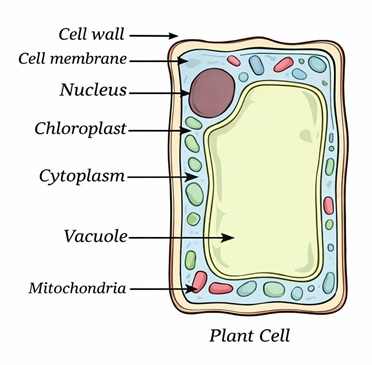
Plant cells are different from animal cells in some ways. Both plant and animal cells have a cell membrane, but plant cells have an extra outer layer called the cell wall. Plant cells also contain additional organelles, such as a large vacuole, which is usually absent or much smaller in animal cells. It also contains chloroplast.
Plant cells have some extra organelles than animal cell are:
1. Cell wall : The outer most layer of plant cell is cell wall.
Functions of Cell Wall
- Provides shape:
Gives a definite shape to the plant cell. - Provides support:
The cell wall in the plant cell provides rigidity and strength to plants. - Protection:
Protects the cell from mechanical injury and external damage. - Prevents bursting:
Protects the cell from bursting when too much water enters. - Permeability:
Allows certain substances (like water and gases) to pass through.
2. Vacuoles: Plant cells also have a large, empty-looking space called a vacuole.
Functions of Vacuole
- Storage:
Stores water, food, salts, and waste materials. - Strength And Support: This gives strength and support to the plant.
- Maintains turgidity:
It maintains the shape of the cell and helps the plant stand upright. - Waste disposal:
Stores and removes unwanted substances from the cell. - Maintains cell pressure:
Helps in maintaining internal pressure of the cell. - Regulates water balance:
Controls the amount of water inside the cell.
3. Plastids: Plastids are tiny rod-shaped structures present in plant cells.
Types of Plastids:
🔹 1. Chloroplast
- Contain chlorophyll
- Green in color
- Help in photosynthesis
🔹 2. Non-green Plastids
- Found in non-green parts of plants
- Do not contain chlorophyll
- Help in storage of food and other substances
Functions of Plastids
- Chloroplasts carry out photosynthesis (chloroplast)
- Non-green plastids store food and nutrients (non-green plastids)
📌 Key Point
- Plastids are found only in plant cells
4. Mitochondria: Mitochondria are cell organelles known as the powerhouse of the cell because they produce energy.
Functions of Mitochondria
🔹 1. Energy Production
- Produce energy in the form of ATP
- Supply energy for all cell activities
🔹 2. Cellular Respiration
- Site where respiration takes place
- Break down food to release energy
🔹 3. Metabolism Support
- Help in various chemical reactions inside the cell
📌 Key Point:
- Found in both plant and animal cells
4. Animal Cells:
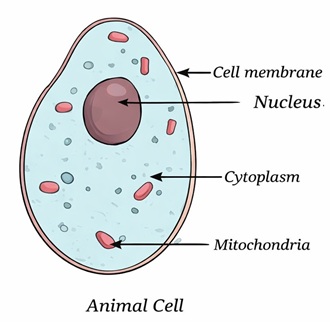
Functions of each organelles of Animal cell is same as plant cell.
Differents between Plant cell and Animal cell.
| Plant Cell 🌿 | Animal Cell 🐾 |
|---|---|
| 1. Plant cell has a cell wall outside the cell membrane. | 1. Animal cell does not have a cell wall. |
| 2. Plant cell is usually rectangular in shape. | 2. Animal cell is usually round or irregular in shape. |
| 3. Plant cell contains chloroplasts for photosynthesis. | 3. Animal cell does not contain chloroplasts. |
| 4. Plant cell has a large central vacuole. | 4. Animal cell has small or no vacuole. |
| 5. Plant cell contains plastids. | 5. Animal cell does not contain plastids. |
| 6. Plant cell stores energy in the form of starch. | 6. Animal cell stores energy in the form of glycogen. |
| 7. Plant cell can make its own food. | 7. Animal cell cannot make its own food. |
| 8. Centrioles are generally absent in plant cells. | 8. Centrioles are present in animal cell |
Muscle Cells
A muscle cell is shaped like a spindle, It has a simple structure without branches.
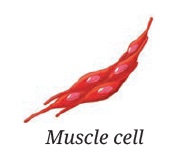
1. It helps in movement and contraction of body parts.
2. Its shape is suitable for contraction and relaxation.
Nerves Cells (Neurons)
Nerve cells also known as neurons. The elongated shape and branched structure. Nerve cells are mainly found in brain, spinal cords, and nervoius tissues of body.
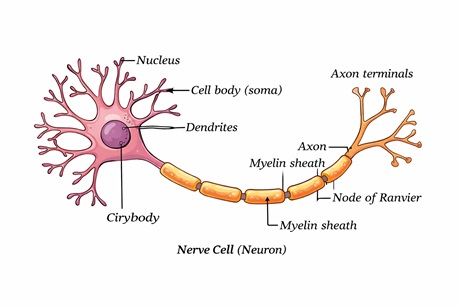
Functions of Nerve cells:
1. Nerves cells carry messages in our body.
2. They help them reach different parts of the body and pass on messages quickly.
Different between Muscle Cell and Nerve Cell.
| Muscle Cell | Nerve Cell (Neuron) |
|---|---|
| 1. A muscle cell is spindle-shaped. | 1. A nerve cell is very long in shape. |
| 2. It has a simple structure without branches. | 2. It has many branches. |
| 3. It helps in movement and contraction of body parts. | 3. It helps in transmitting messages (nerve impulses). |
| 4. Its shape is suitable for contraction and relaxation. | 4. Its shape is suitable for sending signals over long distances. |
5. Levels of Organisation
Definition: Levels of organisation describe how living things are arranged from simple to complex.
The body of a living organism is organised in a complex way. Cell is the basic unit of life, just like a brick is the basic unit of wall.
A group of similar cells forms a type of tissue. Different tissues are organised to form an organ. Several organs work together to form an organ system that performs a major function of the body. All the organ systems together make up a complete organism — like a plant or an animal.
Examples:
- Cell → Tissue → Organ → Organ System → Organism
Types of Organism on the Basis of Cell.
1. Unicellular organisms: Unicellular organisms are organisms made up of a single cell, such as Amoeba.
1. Multicellular organisms: The life of complex living organisms begins with a single cell—‘egg’.
The egg of any organism has an amazing ability to divide repeatedly to form a complete living being made up of many cells. Such living beings are called multicellular organisms.
Animals, including humans, and plants are all examples of multicellularorganisms.
In multicellular organisms, cells carry out specialised functions individually but also cooperate with each other to increase the chance of survival.
🥚 Learning Points (Ostrich Egg Cell)
- The yolk of an ostrich egg is a single cell.
- It is the largest known cell in the living world.
- Its size is about 130 mm to 170 mm in diameter.
- The egg contains non-cellular parts like:
- Shell → provides protection
- Egg white (albumen) → provides nourishment
- The stored nutrients help in the growth and development of the cell.
6. Microorganisms in Environment
Definition: Microorganisms are very small living organisms that cannot be seen with the naked eye.
Types of Microorganisms
Some microorganisms, such as bacteria and protozoa, are made up of just one cell. These are called unicellular (single-celled) organisms.
1. Unicellular Microorganisms: These are organisms made up of only one cell. Examples include bacteria and Amoeba. A single cell performs all life functions.
So, They carry out all the functions necessary for their survival in a single cell
2. Multicellular Microorganisms: These are organisms made up of many cells. Examples include some fungi and algae. Different cells perform different functions.
Some other microbes, like algae and fungi, are made up of one or more cells. For example,
yeast is a unicellular fungus while mould is a multicellular fungus.
- Fungi possess a cell wall but lack chloroplasts, so they cannot perform photosynthesis.
- Bacteria do not have a well-defined nucleus and a nuclear membrane. Instead they have a nucleoid. This feature distinguishes them from cells of yeast, protozoa, algae, fungi, plants, and animals.
Presence of Microorganisms
Found in: Microorganisms are found everywhere around us — in water, soil, air, and even inside the human body.
Key Point
Important: Microorganisms can be unicellular or multicellular and are present all around us.
Examples
- Soil bacteria
- Water microbes
Types
- Decomposers
- Useful microbes
Functions
- Break down waste
- Maintain ecological balance
7. Microorganisms in Food
Definition
Use of microorganisms in preparation and preservation of food.
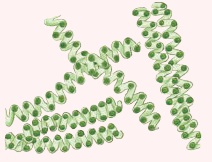
1. Spirulina: Spirulina is a highly nutritious microalga rich in protein and vitamin B12, with low fat and sugar. Due to its health benefits and easy cultivation, it is becoming a promising livelihood opportunity.
2. Yeast: Yeast is a type of microorganism. It belongs to a group of microorganisms, called fungi. Yeast grows well in warm conditions.
Examples
- Yeast – bread making
- Lactobacillus – curd formation
Types
- Fermentation microbes
- Food-producing microbes
Functions
- Improve taste
- Help in food production
8. Nitrogen Fixation
Definition
The process of converting atmospheric nitrogen into usable form for plants.
Examples
- Rhizobium bacteria
Types
- Symbiotic nitrogen fixation
- Free-living bacteria
Functions
- Increases soil fertility
- Helps plant growth
9. Microalgae
Definition:
Microscopic plant-like organisms that perform photosynthesis.
Examples
- Green algae
Types
- Freshwater algae
- Marine algae
Functions
- Produce oxygen
- Serve as food source
10. Biogas Production
Definition
Production of gas from organic waste by microorganisms.
Examples
- Gobar gas plant
Types
- Anaerobic digestion
Functions
- Produces fuel
- Reduces waste
Organisms present in pond water
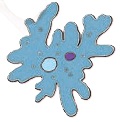
1. Ameoba : Ameoba is a protozoa, It is a single cell, moving, irregular shape
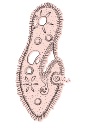
2. Paramecium: it is also a protozoa, which is single cell, moves from one place to another, movement takes place with the help of specialised structures.
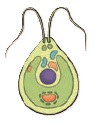
3. Algae: It is a single cell, looks green because of the presence of green pigment, movement
takes place with the help of specialised structures.
Organisms present in soil suspension
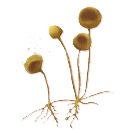
1. Bread mould (Fungi): Branched filament without chlorophyll having sac-like structure
2. Mould (Fungi): Branched filament without chlorophyll having brush-like structure
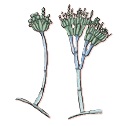
3. Algae: Spherical, presence of chlorophyll — a green pigment
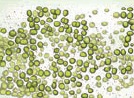
4. Bacteria: Spherical, comma, spiral or rod-shaped, one long hair-like structure and many small hair-like projections around the cell
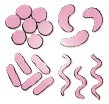
How Microorganisms help us as Friends:
1. The Making of Manures: soil contains various kinds of microorganisms. Some of these microorganisms, like fungi and bacteria, act on the plant waste and slowly break it down into simpler,
nutrient-rich manure.
Manures: The cow dunk, dry leaves, peels of fruits and vegetables have turned into a dark-coloured
material. This dark-coloured materials formed by the decomposed by micro-organisms action. This material is called manure, which is rich in nutrients and helps increase the fertility of the soil.
Decomposition: decaying plants and fallen leaves stored in a container or lying in the garden, disappear after some time from the surroundings. This is because microorganisms breakdown the complex substances of fallen leaves into simpler substances that are rich in nutrients — this process is called decomposition.
These nutrients go back to the soil and help plants grow better. Microorganisms also decompose
bodies of dead animals. So, microbes help recycle the waste and return important nutrients to nature. Manure formation occurs at optimal temperature and appropriate moisture level.
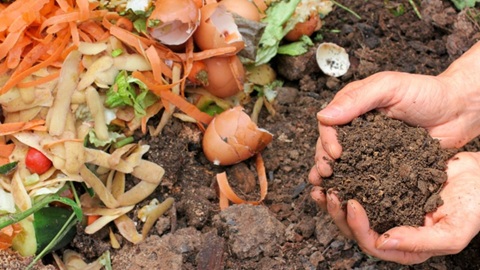
Manure is formed when dead plant materials, dry leaves, and vegetable peels decompose naturally with the help of microorganisms.
🔹 Key Points:
- Made from organic waste like leaves, peels, and plant remains
- Prepared through decomposition (composting)
- Rich in nutrients and improves soil fertility
- Eco-friendly and reduces waste
2. A Source of Biogas: Some microorganisms like bacteria and fungi live without oxygen and decompose plant and animal waste. During this process, they produce biogas mainly containing methane, which is used as a fuel for cooking, heating, electricity, and vehicles.
🔹 Key Points:
- Microbes work in oxygen-free (anaerobic) conditions
- Break down organic waste (plant, animal, wastewater)
- Produce biogas (mainly methane + carbon dioxide)
- Biogas is a clean and renewable fuel
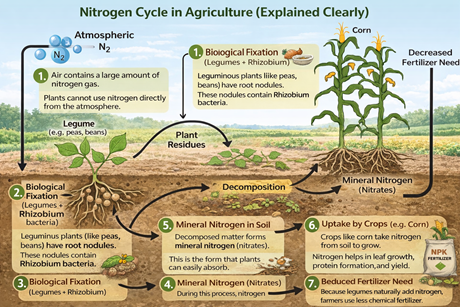
3. Nitrogen Fixation: Certain bacteria like Rhizobium live in root nodules of leguminous plants and convert atmospheric nitrogen into usable forms (nitrates). This natural process improves soil fertility and reduces the need for chemical fertilizers.
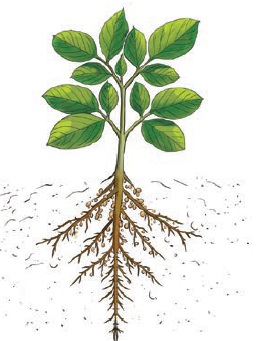
Nitrification: Some certain bacteria convert ammonia or atmospheric nitrogen into nitrates, this process of fixing atmospheric nitrogen into nitrates is called Nitrification. which can be easily absorbed and used by plants.
🔹 Key Points:
- Rhizobium bacteria live in root nodules of legumes (peas, beans, lentils)
- Convert nitrogen gas → nitrates (usable by plants)
- Process called nitrogen fixation (nitrification)
- Improves soil fertility naturally
- Helps in crop rotation to maintain healthy soil
4. Milk Into Curd: By a special process milk turns into curd. This curd is little sour in taste.
The curd contains several types of bacteria. One of them is Lactobacillus. This bacterium feeds on the sugar in the milk (lactose), multiplies, and ferments the milk to form curd. Instead of producing alcohol (like yeast), these bacteria produce lactic acid, which makes curd sour.
5. Nutrition and Oxygen Production by Microorganisms: Microalgae are microscopic plant-like organisms that live in water, soil, air, and even on trees. They make their own food using sunlight. While doing this, they also release oxygen and produce more than half of the Earth’s oxygen supply.
Key points:
- They are rich in nutrients and serve as a food source for many aquatic animals.
- Some, like Spirulina, Chlorella, and Diatoms, are also used by humans as health supplements and medicines.
- Microalgae also help in cleaning water and are used to make biofuel.
Class 8, all subjects CBSE Notes in english medium, cbse class 8 Science Curiosity notes, class 8 Science Curiosity notes english medium, cbse 8 Science Curiosity cbse notes, class 8 Science Curiosity revision notes, cbse class 8 Science Curiosity study material, ncert class 8 science notes pdf, class 8 science exam preparation, cbse class 8 physics chemistry biology notes