 Welcome to ATP Education
 ATP Education
2. Linear Equations in One Variable Mathematics class 8 in English Medium ncert book solutions Exercise 2.2
2. Linear Equations in One Variable Exercise 2.2 – Complete NCERT Book Solutions for Class 8 Mathematics (English Medium). Get all chapter explanations, extra questions, solved examples and additional practice questions for 2. Linear Equations in One Variable Exercise 2.2 to help you master concepts and score higher.

2. Linear Equations in One Variable Mathematics class 8 in English Medium ncert book solutions Exercise 2.2
NCERT Solutions for Class 8 Mathematics play an important role in helping students understand the concepts of the chapter 2. Linear Equations in One Variable clearly. This chapter includes the topic Exercise 2.2, which is essential from both academic and examination point of view. The solutions provided here are prepared strictly according to the latest NCERT syllabus and follow the guidelines of CBSE to ensure accuracy and relevance. Each question is explained in a simple and student-friendly manner so that learners can grasp the concepts without confusion. These NCERT Solutions are useful for regular study, homework help, and exam preparation. All textbook questions are solved step by step to improve problem-solving skills and conceptual clarity. Students of Class 8 studying Mathematics can use these solutions to revise important topics, understand difficult questions, and practise effectively before examinations. The chapter 2. Linear Equations in One Variable is explained in a structured way, making it easier for students to connect the theory with the topic Exercise 2.2. By studying these updated NCERT Solutions for Class 8 Mathematics, students can build a strong foundation, boost their confidence, and score better marks in school and board exams.
2. Linear Equations in One Variable
Exercise 2.2
Exercise 2.2
Q1. If you subtract from a number and multiply the result by , you get . What is the number?
Solution:
Let the number be x
so, the equation will be
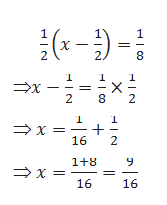
Q2. The perimeter of a rectangular swimming pool is 154 m. Its length is 2 m more than twice its breadth. What are the length and the breadth of the pool?
Solution:
Let the breadth of the swimming pool x.
So, the equation will be 

so, the length of pool 2x + 2
= 2×25 + 2
= 50 + 2
= 52
and the breadth of pool x = 25
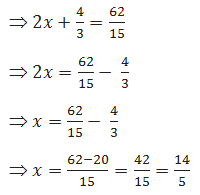
Q3. The base of an isosceles triangle cm the perimeter of a triangle is 4 cm what is the length of either remaining equal sides?
Solution:
Let the length of one remaining equal sides x.So, equation wil 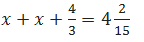
Q4. Sum of two numbers is 95. If one exceeds the other by 15, find the numbers.
Solution:
Let the second number is x.
So, the equation will be x + x + 15 = 95
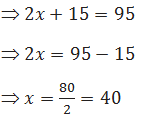
So, the first number will be x + 15
= 40 + 15
= 55
And second number: x = 40
Q5. Two numbers are in the ratio 5:3. If they differ by 18, what are the numbers?
Solution:
Let,
Both numbers will be 5x and 3x
So, the equation will be 5x - 3x = 18
⇒2x = 18

so, the first number will be 5x
= 5 × 9
= 45
and the second number will be = 3 × 9
= 27
Q6. Three consecutive integers add up to 51. What are these integers?
Solution:
Let, all numbers x, x+1, x+2 respectively.
So, the equation will be x+x+1+x+2=51
⇒ 3x +3=51
⇒ 3x=51-3
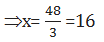
So, the first number will be x = 16
, second number will be x + 1
= 16 + 1
= 17
and the third number will be x + 2 = 18
Q7. The sum of three consecutive multiples of 8 is 888. Find the multiples?
Solution:
Let, three consecutive multiples of 8 is x, x+8, and x+16 respectively
So, the equations will be : x + x + 8 + x + 16 = 888
⇒ 3x + 24 = 888
⇒ 3x = 888 - 24
So, the first multiple x = 288
Second multiple x + 8 = 288+8 = 296
Third multiple x + 16 = 288 + 16 = 304
Q8. Three consecutive integers are such that when they are taken in increasing order and multiplied by 2, 3 and 4 respectively, they add up to 74. Find these numbers.
Solution:
Let, all numbers be x, x+1, x+2
So, the equation will be: 2(x) + 3(x+1) +4(x+2) =74
⇒ 2x+ 3x+3+ 4x+8 = 74
⇒ 9x+11=74
⇒ 9x=74-11

So, first number is x = 7
Second number is x + 1
= 7 + 1 = 8
Third number is x + 2
= 7 + 2
= 9
Q9. The ages of Rahul and Haroon are in the ratio 5:7. Four years later the sum of their ages will be 56 years. What are their present ages?
Solution:
Let, the present ages of Rahul and Haroon be 5x and 7x respectively
So, the equation will be 5x + 4 + 7x + 4 = 56
⇒ 12x + 8 = 56
⇒ 12x = 56 - 8

So, the present age of Rahul: 5x = 5 × 4 = 20
The present age of Haroon: 7x = 7 × 4 = 28
Q10. Aman’s age is three times his son’s age. Ten years ago he was five times his son’s age. Find their present ages.
Solution:
Let, the age of Aman’s son x
⇒5(x - 10) = 3x - 10
⇒ 5x – 50 = 3x - 10
⇒5x – 3x = -10 + 50
⇒2x = 40
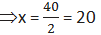
The present age of Aman: 3x = 3 × 20 = 60
The present age of his son: x = 20
See other sub-topics of this chapter:
1. Exercise 2.1 2. Exercise 2.2 3. Exercise 2.3 4. Exercise 2.4 5. Exercise 2.5 6. Exercise 2.6