 Welcome to ATP Education
 ATP Education
Chapter 4. Maps Geography class 6 in English Medium ncert book solutions Additional Questions
Chapter 4. Maps Additional Questions – Complete NCERT Book Solutions for Class 6 Geography (English Medium). Get all chapter explanations, extra questions, solved examples and additional practice questions for Chapter 4. Maps Additional Questions to help you master concepts and score higher.
Chapter 4. Maps Geography class 6 in English Medium ncert book solutions Additional Questions
NCERT Solutions for Class 6 Geography play an important role in helping students understand the concepts of the chapter Chapter 4. Maps clearly. This chapter includes the topic Additional Questions, which is essential from both academic and examination point of view. The solutions provided here are prepared strictly according to the latest NCERT syllabus and follow the guidelines of CBSE to ensure accuracy and relevance. Each question is explained in a simple and student-friendly manner so that learners can grasp the concepts without confusion. These NCERT Solutions are useful for regular study, homework help, and exam preparation. All textbook questions are solved step by step to improve problem-solving skills and conceptual clarity. Students of Class 6 studying Geography can use these solutions to revise important topics, understand difficult questions, and practise effectively before examinations. The chapter Chapter 4. Maps is explained in a structured way, making it easier for students to connect the theory with the topic Additional Questions. By studying these updated NCERT Solutions for Class 6 Geography, students can build a strong foundation, boost their confidence, and score better marks in school and board exams.
Chapter 4. Maps
Additional Questions
Additional Question:
Que: When do you use a globe?
Ans: We use a globe when we want to study the earth as a whole.
Que: What is an antlas?
Ans: An atlas is a collection of maps.
Que: What do physical maps show?
Ans: Political maps show natural features of the earth such as mountains, plateans, plains, rivers, oceans, etc.
Que: What do political maps show?
Ans: Political maps show cities, towns and villages and different countries and state of world with their boundaries.
Que: What do you mean by a thematic map?
Ans: A map which gives focus on specific information is konwn as thematic map. For example, road maps, maps showing distribution of industries, etc.
Que: Differentiate between a small scale maps and a large scale map.
Ans:
(i) A small scale map is used to show large areas like continents or countries on a paper while a large scale map is used to show area such as village or town on a paper.
(ii) A large scale map is more informative than a small scale map.
Que: What is called the northline?
Ans: Maps usually contain an arrow marked with the letter 'N' at the upper right hand comer. This arrow shows the north direction and is called the north line.
Que: What is a compass?
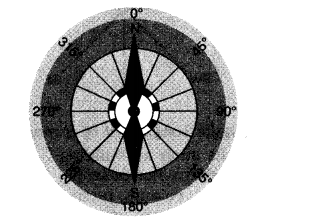
Ans: A compass is an instrument used to find out main directions.
Que: What are conventional symbols?
Ans: Some symbols have a fixed meaning and are understood uniformally through out the world. Such symbols are known as conventional symbols.
Que: What colours are used for the following:
(i) mountains
(ii) plain
(iii) plateaus
(iv) water bodies
Ans:
(i) Mountains - Brown colour
(ii) plains - Green
(iii) plateaus - yellow
(iv) water bodies - Blue
Que: What is a sketch map?
Ans: A sketch map is a rough drawing of an area. It is draw without scale.
Que: What is plan?
Ans: A paln is a drawing of a small area on a large scale.
Que: Differentiate between scale map and a large scale map.
Ans:
(i) A small scale map is used to show large areas like continents or countries on a paper while a large scale map is used to show a small area such as village or town on a paper.
(ii) A large scale map is more informative than a small scale map.
Que: What are cardinal points and intermediate directions?
Ans: The four major directions - North, South, East and West are called cardinal points. Beside these major directions we have intermediate directions - North - East (NE), South - East (SE), south - West (SW) and North - West (NW). The intermediate directions are very helpful in locating any placce more accurately.
Que: Write a note on 'compass'.
Ans: The direction of a place is traced out with the help of a compass. It is an instrument Used to find our main directions. It magnetic needle always points towards north - south direction.
Que: Define and discuss 'distance' as a component of a map.
Ans: Maps are drawing. They reduce the whole world or a part of it to fit on a sheet of paper. In other words we ca say that maps are drawn to reduced scales. but it needs great care while doing this reduction work in order to keep the distance between the real places. It can be possible when a small distance on paper represents a large distance on the ground. For this purpose a scale is used.
Scale is the between the actual distance on the ground and the distance shown on the map. We can understand this with the help of an example. Suppose, the distance between your coaching centre and your school is 8km. If you show this 8km distance by 2cm on a map. It means, 1cm on the map will show 4km on the ground. Thus, the scale of your drawing will be 1cm = 4km scale is very important in any map.
If scale is known, calculation of distance between anyb two places on a map will be easy. A small scale is used to show large areas on a paper like continents or countries. For example, 10cm on the map shows 1000km of the ground. A large scale is used to show a small area like a village or town on paper. For example, 10cm on the map shows 1000 metres only on the ground.
Que: GIve an account of 'direction' as a major component of a map?
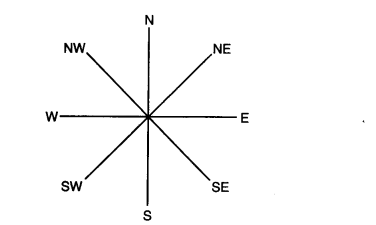
Ans: Direction is an important component of a map. Most maps contain an arrow marked with the letter 'N' at the upper right hand comer. This arrow show the north direction. It is called the north line. After knowing the north direction, other directions, east, west and south can be easily found out.
There are four major directions - North, South, East and West. They are called cardinal points. Besides these, there are four intermediate directions. They are north - east (NE), south - east (SE), south - west (SW) and north - west (NW). Location of any place with more accuracy can be possible with the help of these intermediate directions.
:
Que: Discuss symbols as a major component of a map.
Ans: Drawing different features such as building, roads, etc. in their actual shape and size on a map is perhaps not possible, it is therefore, they are shown by using certain letters, shapes, colours, pictures and lines. These are symblos that give a lot of information is a limited space.
With the use of these symbols, maps can be drawn easily and are simple to read. These symbols help us greatly in a situation when don't know the language of an area and therefore cannot ask someone for directions. We can collect information from maps with thw help of these symblos.
Maps have a universal language known and understood by all. There is an international agreement regrading the use of these symbols, which are known as conventional symbols.