Welcome to ATP Education
 ATP Education
10. Straight Lines Mathematics class 11 in English Medium ncert book solutions Exercise 10.1
10. Straight Lines Exercise 10.1 – Complete NCERT Book Solutions for Class 11 Mathematics (English Medium). Get all chapter explanations, extra questions, solved examples and additional practice questions for 10. Straight Lines Exercise 10.1 to help you master concepts and score higher.

10. Straight Lines Mathematics class 11 in English Medium ncert book solutions Exercise 10.1
NCERT Solutions for Class 11 Mathematics play an important role in helping students understand the concepts of the chapter 10. Straight Lines clearly. This chapter includes the topic Exercise 10.1 , which is essential from both academic and examination point of view. The solutions provided here are prepared strictly according to the latest NCERT syllabus and follow the guidelines of CBSE to ensure accuracy and relevance. Each question is explained in a simple and student-friendly manner so that learners can grasp the concepts without confusion. These NCERT Solutions are useful for regular study, homework help, and exam preparation. All textbook questions are solved step by step to improve problem-solving skills and conceptual clarity. Students of Class 11 studying Mathematics can use these solutions to revise important topics, understand difficult questions, and practise effectively before examinations. The chapter 10. Straight Lines is explained in a structured way, making it easier for students to connect the theory with the topic Exercise 10.1 . By studying these updated NCERT Solutions for Class 11 Mathematics, students can build a strong foundation, boost their confidence, and score better marks in school and board exams.
10. Straight Lines
Exercise 10.1
Exercise 10.1
Q1. Draw a quadrilateral in the Cartesian plane, whose vertices are (– 4, 5), (0, 7), (5, – 5) and (– 4, –2). Also, find its area.
 Solution:
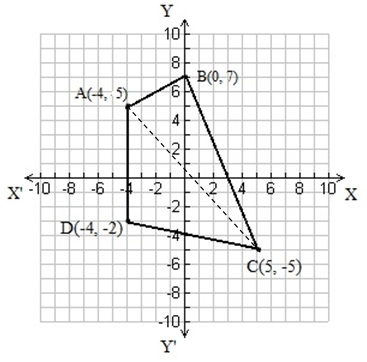
Let ABCD be the given quadrilateral with vertices A (–4, 5), B (0, 7), C (5, –5), and D (– 4, –2).
Now, by plotting A, B, C, and D on the Cartesian plane and joining AB, BC, CD, and DA, the given quadrilateral can be drawn as joining Point A to C forms a diagonal AC.
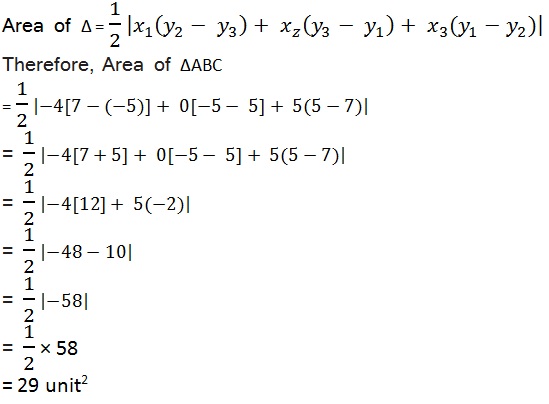
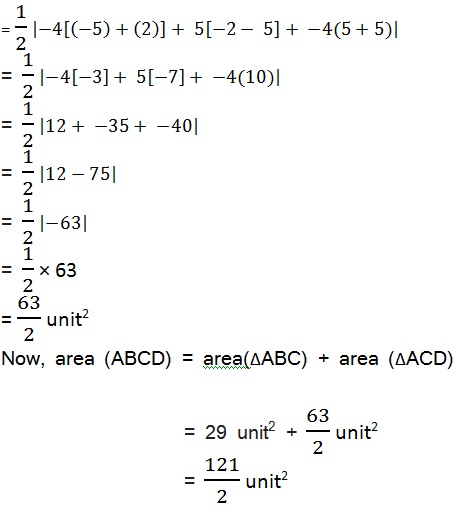
Accordingly, area (ABCD) = area(∆ABC) + area (∆ACD)
Using area of triangle formula.
Therefore, Area of ∆ACD where A (-4, 5), C (5, -5), D (-4, -2)
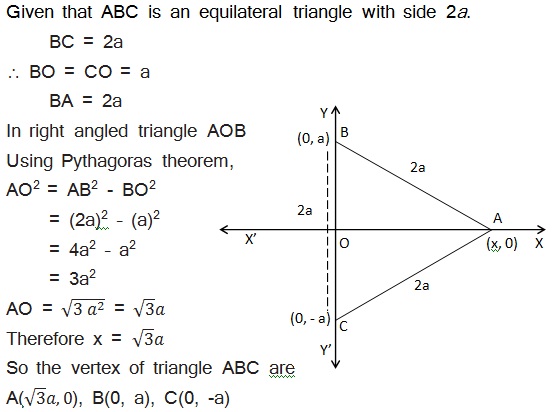
Q2. The base of an equilateral triangle with side 2a lies along the y-axis such that the mid-point of the base is at the origin. Find vertices of the triangle.
Solution:
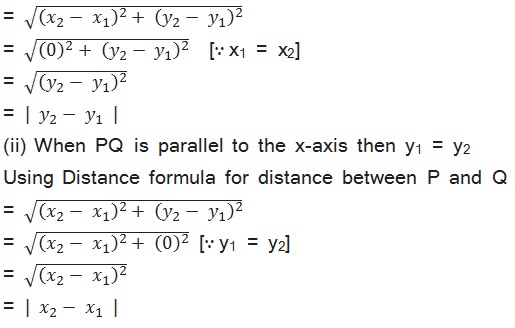
Q3. Find the dis tance between P (x1, y1) and Q (x2, y2) when: (i) PQ is parallel to the y-axis, (ii) PQ is parallel to the x-axis.
Solution:
Given points are : P(x1, y1) and Q(x2, y2)
(i) When PQ is parallel to the y-axis then x1 = x2
Using Distance formula for distance between P and Q
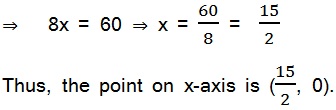
Q4. Find a point on the x-axis, which is equidistant from the points (7, 6) and (3, 4).
Solution:
Let the point on x-axis be P (x, 0) which is equidistance from points A (7, 6) and B (3, 4).
Accordingly,
AP = BP
Or AP2 = BP2 [Squaring both sides]
⇒ (x – 7)2 + (0 – 6)2 = (x – 3)2 + (0 – 4)2
⇒ x2 – 14x + 49 + 36 = x2 – 6x + 9 + 16
⇒ x2 – 14x + 85 = x2 – 6x + 25
⇒ 85 – 25 = 14x – 6x
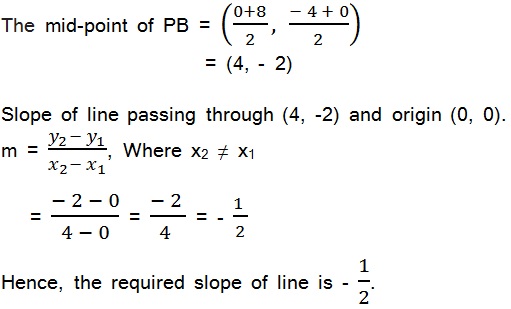
Q5. Find the slope of a line, which passes through the origin and the mid-point of the line segment joining the points P (0, – 4) and B (8, 0).
Solution:
The coordinates of the mid-point of the line segment joining the points P (0, – 4) and B (8, 0).
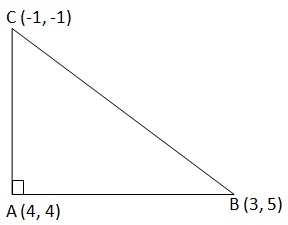
Q6. Without using the Pythagoras theorem, show that the points (4, 4), (3, 5) and (–1, –1) are the vertices of a right angled triangle.
Solution:
The vertices of the given triangle are
A (4, 4), B (3, 5), and C (–1, –1).
If given vertices are of a right angle triangle.
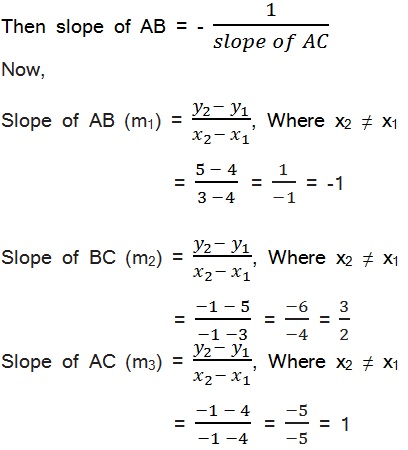
m1m3 = -1
Slope of AB (m1) × Slope of AC (m3) = -1
It means side AB and AC are perpendicular to each other.
Here, given triangle is right-angled at point A (4, 4).
Thus, the points (4, 4), (3, 5), and (–1, –1) are the vertices of a right-angled triangle.
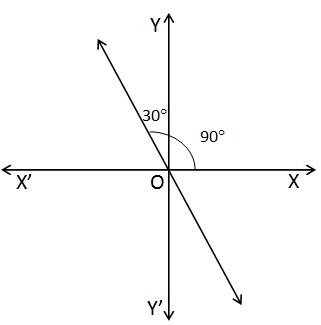
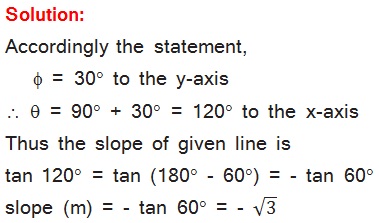
Q7. Find the slope of the line, which makes an angle of 30° with the positive direction of y-axis measured anticlockwise.
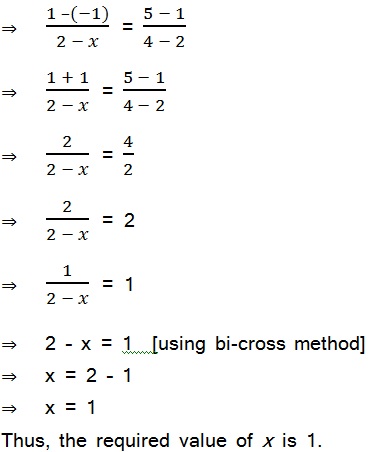
Q8. Find the value of x for which the points (x, – 1), (2,1) and (4, 5) are collinear.
Solution:
Let point be A (x, –1), B (2, 1), and C (4, 5).
If points A (x, –1), B (2, 1), and C (4, 5) are collinear, then
Slope of AB = Slope of BC
Q9. Without using distance formula, show that points (– 2, – 1), (4, 0), (3, 3) and (–3, 2) are the vertices of a parallelogram.
Solution:
To be the points A(– 2, – 1), B(4, 0), C(3, 3) and D(–3, 2) of the vertices of a parallelogram.
There must be AB || CD or BC || AD
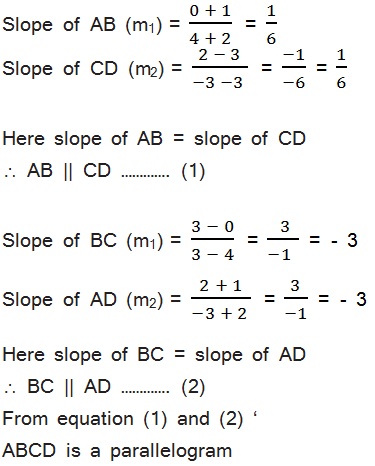
Thus, points (–2, –1), (4, 0), (3, 3), and (–3, 2) are the vertices of a parallelogram.
Q10. Find the angle between the x-axis and the line joining the points (3,–1) and (4,–2).
Solution:
Let be points A(3,–1) and B(4,–2) are given for a line.
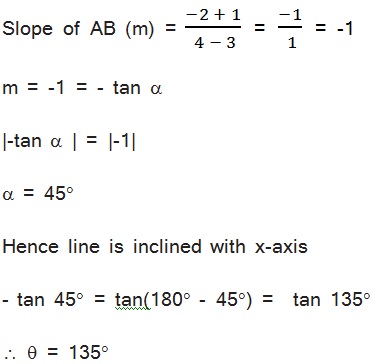
Thus, the angle between the x-axis and the line joining the points (3, –1) and (4, –2) is 135°.

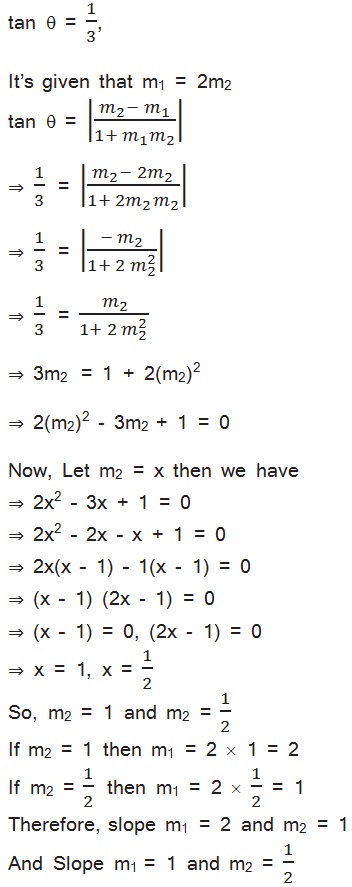
Solution:
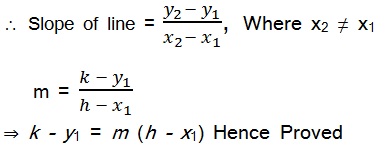
Q12. A line passes through (x1, y1) and (h, k). If slope of the line is m, show that k – y1 = m (h – x1).
Solution:
Line passes through points (x1, y1) and (h, k).
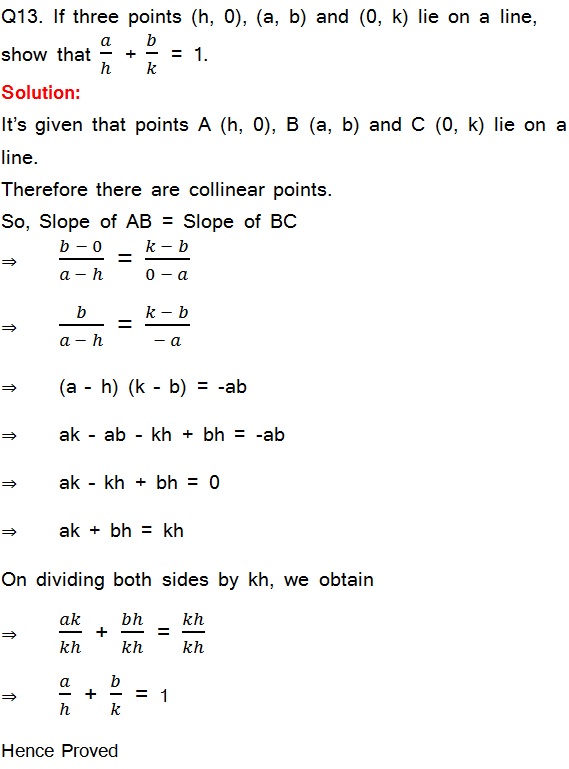
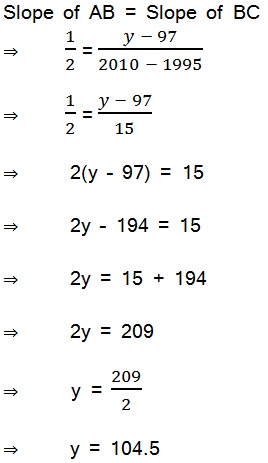
Q14. Consider the following population and year graph, find the slope of the line AB and using it, find what will be the population in the year 2010?

Solution:
Line AB passes through points A(1985, 92) and B(1995, 97).
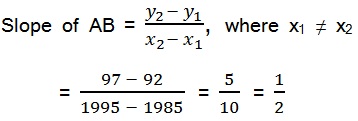
Let y be the population in the year 2010. Then, according to the given graph, line AB must pass through point C (2010, y).