 Welcome to ATP Education
 ATP Education
Class 9 science Solutions English Medium
Download latest NCERT Solutions for Class 9 based on CBSE 2026-27 syllabus. Get chapter-wise detailed explanations, step-by-step answers, important questions and exam-ready study material in Hindi and English medium.
Topics Covered In This Article
NCERT Solutions for CBSE Board Classes 6 to 12, ncert solutions for all classes, NCERT SOLUTIONS, online NCERT solutions, NCERT, ncert, ncert solutions, ncert solutions for board exams, ncert Maths solution, Mathematics, ncert science solutions, ncert English book solutions, ncert Hindi book solutions, ncert Social Science book solutions, ncert accounts book solutions, Computer Education, solved question answer for all exercise
Class 9 science Solutions English Medium
NCERT Solutions for Class 9 are specially prepared according to the latest CBSE syllabus (2026-27) to help students understand every concept clearly. These solutions provide step-by-step explanations, accurate answers, and exam-oriented guidance for all chapters. Class 9 students can improve their problem-solving skills, strengthen conceptual understanding, and prepare confidently for school as well as board examinations. All questions are solved in a simple and easy-to-understand language for both Hindi and English medium learners.
Class 9 science Solutions English Medium
NCERT Solutions Class 9 science English Medium
12. Sound
Topic: Sound Wave
Sound Wave : Sound is known as the wave and wave is disturbance which is produced by a vibrating object. These wave are longitudinal wave which create by compression and rarefaction.
Sound wave is mechanical wave: Sound waves need medium to propagate from one place to another, in otherhand it need body for transmission, this is the reason that sound waves are called mechanical waves.
Common medium for the propagation of sound : Air is common medium.
Sound waves are longitudinal waves:
Sound wavves are longitudinal waves because the displacement of particles of medium occure parallel to the direction of propagation in these waves. The particles do not move from one place to another but they oscillate in to and fro motion ramain about mean position as the waves travel. Just like this sound waves propagate, therefore sound waves are longitudinal waves.
Features of sound waves:
There are following features of sound waves:
(i) Frequency
(ii) Amplitude
(iii) Velocity
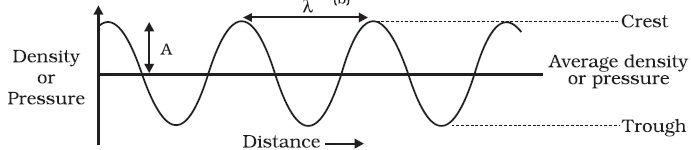
Wavelength : The distance between two consecutive compressions (C) or two consecutive rarefactions (R) is called the wavelength.
Or the distance covered by a wave to complete an oscillation is called wavelength.
Hence wavelength is kind of length, therefore the S.I unit of wavelength is metre (m).
Wavelength is represented by Greek letter λ (lambda).
Frequency: The number of oscillation completed in one second is called frequency.
S.I unit of frequncy is Hertz(Hz).
Time Period : The time taken to complete one oscillation is called it's time period.
- SI unit of time period is second (s). Time period is denoted by T.
- The frequency of a wave is the reciprocal of the time period.

Amplitude : The maximum displacement of the particles of medium from their original undisturbed position (equilibrium position) during the propagation of wave is called amplitude.
Amplitude is denoted by A and its SI unit is metre (m).
Representing graphically the density and pressure variations.
Sound have characteristics like pitch, loudness and timbre.
Crest: A pick of sound wave is called crest.
Trough: A valley of the sound wave is called trough.
Timbre : The quality or timber of sound is that characteristic which enables us to distinguish one sound from another having the same pitch and loudness.
Tone : A sound of single frequency is called a tone.
Note : The sound which is produced due to a mixture of several frequencies is called a note and is pleasant to listen.
Noise: The sound which is unpleasant to ear is called noise.
The speed of sound : The speed of sound is defined as the distance which a point on a wave, such as a compression or a rarefaction, travels per unit time.
Speed (v) = distance/time
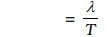
λ is wavelength
T is time period
or v = λ ν
That is, speed = wavelength × frequency.
- The speed of sound remains almost the same for all frequencies in a given medium under the same physical conditions.
Example 1. A sound wave has a frequency of 2 kHz and wave length
35 cm. Find the speed of sound.
Solution:
Given,
Frequency, ν = 2 kHz = 2000 Hz
Wavelength, λ = 35 cm = 0.35 m
Speed (v) = wavelength × frequency
= λ ν
= 0.35 × 2000
= 700 m/s
Therefore speed is 700 m/s
Example 2. Calculate the wavelength of a sound wave whose frequency is 220 Hz and speed is 440 m/s in a given medium.
Solution:
Frequency = 220 Hz
Speed = 440 m/s
Wavelength = speed/frequency
= 440/220
= 2 m
Therefore, wavelength is 2 m
Intensity of sound : The amount of sound energy passing each second through unit area is called the intensity of sound.
Loudness of sound : Loudness is a measure of the response of the
ear to the sound.
Factors on which the loudness of sound depends:
(i) Loudness of sound depends on apletudes of vibration.
Transverse wave:
1. Particles of the medium moves in a direction parallel to the direction of propagation of the disturbance.
2. It forms compression and rarefaction.
3. Example – light wave.
Longitudinal wave:
1. Particles do not oscillate along the line of wave propagation but oscillate up and down about their mean position as the wave travels
2. It forms crest and trough.
3. Example – sound wave.
NCERT Solutions Class 9 Hindi and English Medium – Complete Study Material
NCERT Solutions Class 9 students ke liye specially CBSE latest syllabus (2026-27) ke according prepare kiye gaye hain. Yeh solutions Hindi aur English medium dono ke liye available hain, jisse har student apni language preference ke hisaab se padh sakta hai. Har chapter ke sabhi prashnon ke step-by-step answers diye gaye hain jo concept clarity aur exam preparation me madad karte hain.
Chapter-Wise Detailed Explanations
Class 9 ke liye diye gaye Chapter Wise NCERT Solutions me har question ka detailed aur easy explanation diya gaya hai. Chahe aap CBSE Board Exam Preparation kar rahe ho ya school test ke liye revise kar rahe ho, yeh solutions aapko complete understanding denge. Har answer simple language me likha gaya hai jisse students concepts ko easily grasp kar saken.
Hindi and English Medium Support
Students Hindi aur English medium dono me NCERT Book Solutions Class 9 access kar sakte hain. Yeh dual language support un students ke liye helpful hai jo apni regional language me better samajhna chahte hain. Sabhi answers CBSE Latest Syllabus 2026-27 ke anusaar update kiye gaye hain.
Important Features of NCERT Solutions
- Class 9 NCERT Solutions PDF
- CBSE Class 9 Study Material
- NCERT Book Questions and Answers
- Exam Oriented Important Questions
- Step-by-Step Detailed Solutions
- Concept Clarity and Revision Notes
Why Students Should Use NCERT Solutions?
Aaj ke competitive environment me sirf textbook padhna kaafi nahi hota. NCERT Solutions for Class 9 students ko practice aur conceptual understanding dono provide karte hain. Yeh solutions unhe exam pattern samajhne, frequently asked questions practice karne aur high score achieve karne me madad karte hain. Regular practice se students apne weak topics ko improve kar sakte hain.
Best Resource for Exam Preparation
Agar aap Class 9 CBSE Preparation ke liye ek trusted aur reliable source dhundh rahe hain, to yeh NCERT Solutions perfect choice hain. Yeh study material school exams, unit tests, half-yearly aur annual exams ke liye equally useful hai. Har chapter ke answers accurate, verified aur student-friendly format me diye gaye hain.
Isliye agar aap NCERT Solutions Class 9 Hindi and English Medium search kar rahe hain, to yahan aapko complete chapter-wise solutions milenge jo aapki academic journey ko strong aur confident banayenge.