Welcome to ATP Education
 ATP Education
Chapter-4. Principle of Mathematical Induction Mathematics class 11 in english Medium CBSE Notes
CBSE Class 11 Mathematics Notes in English Medium based on latest NCERT syllabus, covering definitions, diagrams, formulas, and exam-oriented explanations.

4. Principle of Mathematical Induction
Introduction
4. Principle of Mathematical Induction
Mathematical induction is a technique for proving a statement, theorem, or a formula, that is asserted about every natural number.
The word induction means the generalisation from particular cases or facts.
Statement: A sentence which can be judged to be true or false is called statement.
Mathematical example:
(i) Eight is divisible by two.
(ii) Any number divisible by two is an even number,
therefore,
(iii) Eight is an even number.
Here statements (i) and (ii) are true, so
using (i) and (ii)
(iii) is also true
Deduction: Deduction is a process in which a statement is given to be proven, often called a conjecture or a theorem in mathematics. deduction is the application of a general case to a particular case.
The Principle of Mathematical induction:
Concept:
(i) If a statement is true for one event then statement will be true for all given events.
This is the underlying principle of mathematical induction.
Steps:
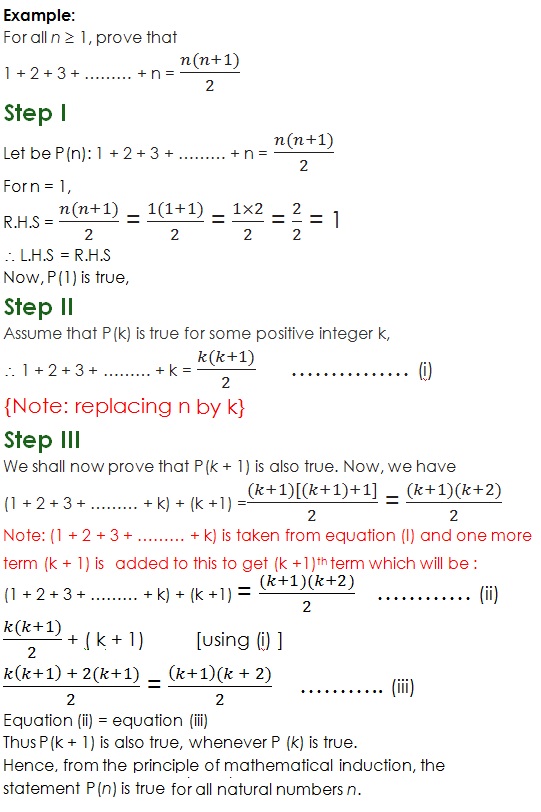
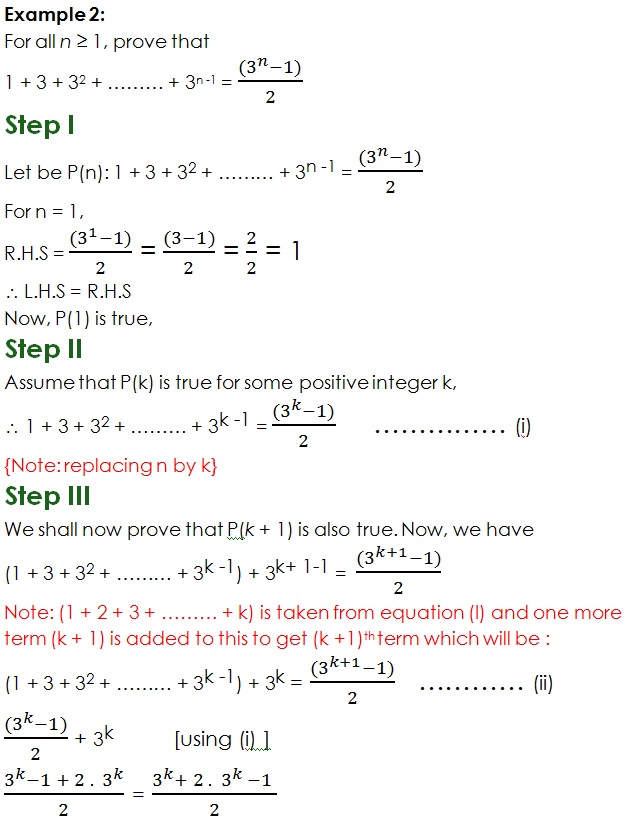
Suppose there is a given statement P(n) involving the natural number n such that:
Step I:
First prove for P(1) where n =1 and n ∈ N;
When P(1) is true
then
Step II
Assume that P(k) is true for some positive integer k,
And replace n by k and make that a equation (I)
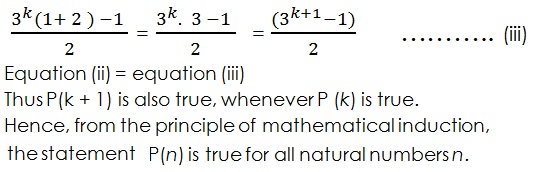
Step III
Then Add a extra term e.i (k +1) in equation I and replace n by (k + 1) from formula.
Then prove for (k + 1)