 Welcome to ATP Education
 ATP Education
Chapter-12. Electricity Science class 10 in english Medium CBSE Notes
CBSE Class 10 Science Notes in English Medium based on latest NCERT syllabus, covering definitions, diagrams, formulas, and exam-oriented explanations.

12. Electricity
joules law of heating
joule's law of heating:
The heat produced in a resistor is directly proportional to the square of current
for a given resistance, directly proportional to resistance for a given current, and the time for which the current flows through the resistor. This law is called the joule's law of heating.
Joule's law heating is denoted by "H"
H = I2Rt
Establishment of this law in formulla:
Let us suppose that current (I) is flowing through a resistor of resistance
(R) for the time (t). The potential difference across the resistance is (V).
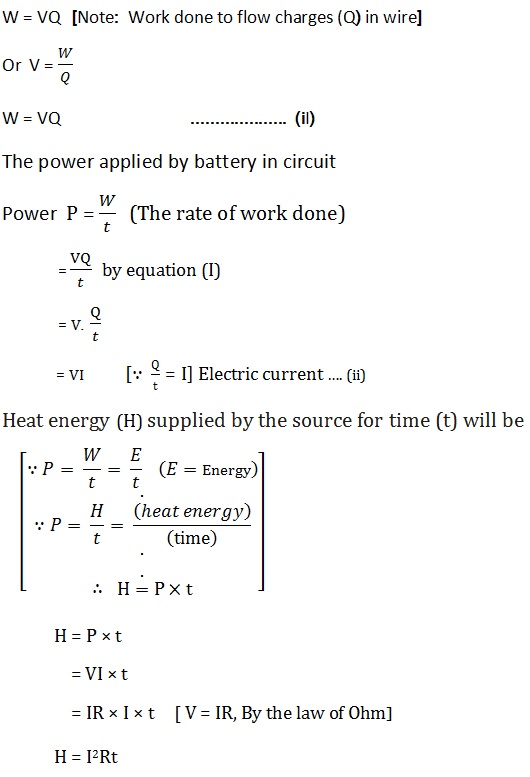
The law stated that the heat produced in a resistor is :
(i) Directly proportional to the square of current (I) for a given resistance.
(ii) Directly proportional to resistance (R) for a given current.
(iii) Directly proportional to the time for which the current flows through the resistor.
See other sub-topics of this chapter:
2. Resistors in series and parallel ohm law