 Welcome to ATP Education
 ATP Education
Chapter-12. Electricity SCIENCE class 10 in english Medium CBSE Notes
CBSE Class 10 SCIENCE Notes in English Medium based on latest NCERT syllabus, covering definitions, diagrams, formulas, and exam-oriented explanations.

12. Electricity
joules law of heating
joule's law of heating:
The heat produced in a resistor is directly proportional to the square of current
for a given resistance, directly proportional to resistance for a given current, and the time for which the current flows through the resistor. This law is called the joule's law of heating.
Joule's law heating is denoted by "H"
H = I2Rt
Establishment of this law in formulla:
Let us suppose that current (I) is flowing through a resistor of resistance
(R) for the time (t). The potential difference across the resistance is (V).
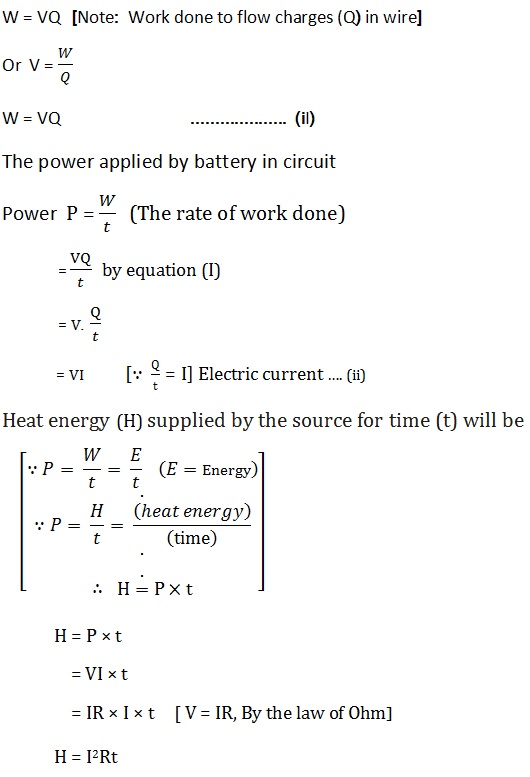
The law stated that the heat produced in a resistor is :
(i) Directly proportional to the square of current (I) for a given resistance.
(ii) Directly proportional to resistance (R) for a given current.
(iii) Directly proportional to the time for which the current flows through the resistor.
See other sub-topics of this chapter:
2. Resistors in series and parallel ohm law
Class 10, all subjects CBSE Notes in english medium, cbse class 10 SCIENCE notes, class 10 SCIENCE notes english medium, cbse 10 SCIENCE cbse notes, class 10 SCIENCE revision notes, cbse class 10 SCIENCE study material, ncert class 10 science notes pdf, class 10 science exam preparation, cbse class 10 physics chemistry biology notes