 Welcome to ATP Education
 ATP Education
Chapter-4. Quadratic Equations Mathematics class 10 in english Medium CBSE Notes
CBSE Class 10 Mathematics Notes in English Medium based on latest NCERT syllabus, covering definitions, diagrams, formulas, and exam-oriented explanations.

4. Quadratic Equations
introduction-Natures of root
Quadratic Equations
Introduction:
The equation ax2 + bx + c = 0, is the standard form of a quadratic equation, where a, b and c are real numbers and a ≠ 0.
Example:
1. 3x2 - 5x = 0,
This equation can be expressed in the form of ax2 + bx + c = 0. then
a = 3, b = -5, c = 0,
Here c = 0, As Term c is disappear.
This also showing a ≠ 0. Hence this is a quadratic equation.
2. 5x2 + 2x -7=0,
Here a = 5, b = 2, c = -7, so it can be also expressed in the form of ax2 + bx + c =0,
3. 3x2 ,
This is single term polynomial i.e mononomial. It can be also expressed in the form of ax2 + bx + c = 0. In which a= 3, b = 0, c = 0, Here b = 0, c = 0 but there is no a ≠ 0.
So, this is also a quadratic equation.
4. 4x + 9,
This cannot be expressed in the form of ax2 + bx + c = 0. As the ax2 term is disappear. Hence a = 0. Which can not fulfill the condition of to be a quadratic equation.
- All quadratic polinomials can be expressed in the form of quadratic equation ax2 + bx + c = 0.
- ax2 + bx + c = 0, a ≠ 0 is called the standard form of a quadratic equation.
Another equations which are not a quadratic equation.
1. x3 + 3x2 + 4x + 5, 2x3 + 4x, 4x3 - 5x2 + 7 and all cubic polynomials.
2. All linear equations like 4x + 3, 5x, 7x + 2 etc.
4. Polynomials of power more than 2 and less than 2.
Nature of Roots:
Roots of Quadratic equations:
- Each quadratic equation has two roots. they are said to be α and β.
- A real number α is said to be a root of the quadratic equation ax2 + bx + c = 0, a ≠ 0. If ax2 + bx + c = 0, the zeroes of quadratic polynomial ax2 + bx + c and the roots of the quadratic equation ax2 + bx + c = 0 are the same.
- The roots of a quadratic equation ax2 + bx + c = 0, a ≠ 0 gives;
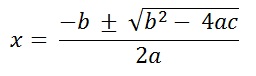
Where b2 - 4ac ≥ 0.
Since b2 – 4ac determines whether the quadratic equation ax2 + bx + c = 0 has real roots or not, b2 – 4ac is called the discriminant of this quadratic equation and Discriminant is denoded by capital Letter D.
Hence,
D = b2 – 4ac,
Nature of Roots of Quadratic Equations:
Nature of Roots:
Using Quadratic formula we have

See here b2 - 4ac given in under root.
This valuue b2 - 4ac is called Discriminant.
Which is denoted by "D".
∴ D = b2 - 4ac
[ Nature of root is determined by the value of Discriminant;]
There are three natures of roots.
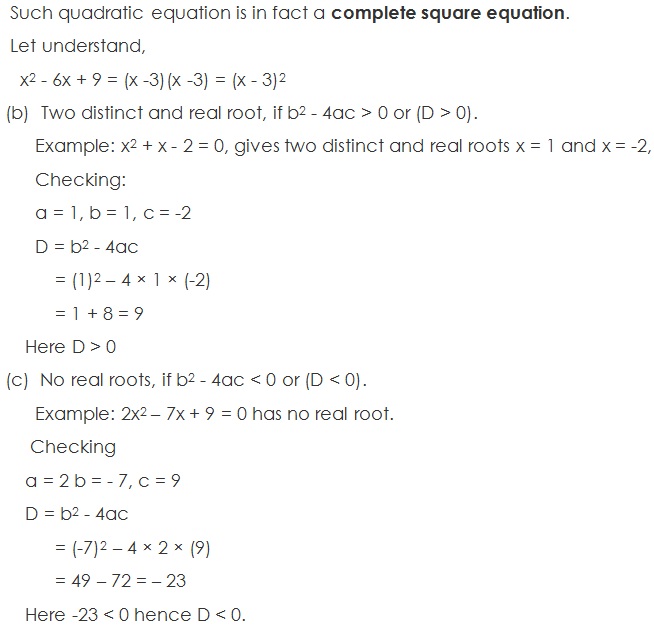
(a) D = 0; [Two equal and real roots, if b2 - 4ac = 0 or (D = 0)]
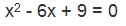
Example:
Solution:
x2 - 6x + 9 = 0
a = 1, b = -6, c = 9
Checking for existance of roots,
D = b2 - 4ac
D = (-6)2 - 4 × 1 × 9
D = 36 - 36
D = 0
Hence D = 0
∴ There is two equal and real roots [Nature-I ]
This equation gives two equal and real roots x = 3, and x = 3.
Such equation which have equal and real root is also called a complete square equation.
(b) D > 0; [ Two real and distinct root]
Example;
7x2 + 2x - 3 = 0
Solution:
7x2 + 2x - 3 = 0
a = 7, b = 2, c = -3
Checking for existance of roots,
D = b2 - 4ac
D = (2)2 - 4 × 7 × -3
D = 4 - (-84)
D = 4 + 84
D = 88
Hence D > 0
∴ There is two real and distinct roots [Nature-II]
(c) D < 0; No Real roots
Example
8x2 + 5x + 3 = 0
Solution:
8x2 + 5x + 3 = 0
a = 8, b = 5, c = 3
Checking for existance of roots,
D = b2 - 4ac
D = (5)2 - 4 × 8 × 3
D = 25 - 96
D = -71
Hence D < 0
∴ There is no roots [Nature-III]
See other sub-topics of this chapter:
1. introduction-Natures of root